>
Siluriformes (Catfishes) >
Callichthyidae (Callichthyid armored catfishes) > Corydoradinae
Etymology: apiaka: Named for the indigenous tribe Apiaká, meaning 'people' in Tupi language, which originally occupied the middle and lower rio Arinos, lower rio Juruena, but is nowadays restricted to the lower rio Juruena. The tribe is known for facial tattoos and bravery in battles, as well as by anthropophagic rites after fights. A noun in apposition.
Eponymy: Apiaká are an indigenous people who originally occupied the middle and lower Rio Arinos, Mato Grosso, Brazil. This tribe is known for facial tattoos, bravery in battles, and anthropophagic rites after fights. (Ref. 128868), visit book page.
Ambiente: milieu / zona climática / intervalo de profundidade / gama de distribuição
Ecologia
; Água doce demersal. Tropical
South America: tributaries of rio Arinos, rio Teles Pires and rio Preto of the rio Tapajós basin in Brazil.
Tamanho / Peso / Idade
Maturidade: Lm ? range ? - ? cm
Max length : 3.9 cm SL macho/indeterminado; (Ref. 102660)
Descrição breve
Chaves de identificação | Morfologia | Morfometria
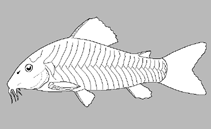
Espinhos dorsais (total) : 2; Raios dorsais moles (total) : 8; Raios anais moles: 8. Corydoras apiakacan be diagnosed from its spotted congeners by having smaller dorsal-fin spine than the three anterior branched dorsal-fin rays (vs. dorsal-fin spine smaller than just two anterior dorsal-fin rays, or equal in size). It differs from its congeners, with the exception of C. albolineatus, C. araguaiaensis, C. haraldschultzi, C. julii,C. polystictus, C. multimaculatus and C. xinguensis, by having numerous dark-brown spots over the head and body (vs. absence of spots). It can be distinguished from C. albolineatus, C. araguaiaensis and C. haraldschultzi by having several spots scattered all over the head and trunk in a somewhat random pattern (vs. spots more concentrated and with a single pale horizontal stripe in the middle of the body in C. albolineatus; or spots arranged in three or more stripes along the trunk in C. araguaiaensis and C. haraldschultzi); pectoral, pelvic and anal fins hyaline (vs. several series of small blotches over fin rays), and adipose fin hyaline or bearing one spot (vs. two or more spots). Corydoras apiaka further differs from C. multimaculatus and C. xinguensisby the absence of blotches on interradial membrane of dorsal fin (vs. presence); adipose fin hyaline or with a single spot (vs. two or three well defined spots); spots not reaching over the anal fin base (vs. spots extending to anal-fin base). It is distinguished from C. xinguensisby the absence of spots onanal fin (vs. presence); body spots with diffuse border (vs. spots with well delimited edge). It can be further separated from all other spotted species, except C. multimaculatus, by the naked ventral region (vs. belly with small platelets) (Ref. 102660).
Facultative air-breathing (Ref. 126274); Most inhabits lotic environment in the rio Arinos and its tributaries. The rio Arinos is characterized by muddy-brown color and soft bottom of clay and sand. Collected mostly in small forest streams of black or clear water, or in marginal ponds (Ref. 102660).
Ciclo de vida e comportamento de acasalamento
Maturidade | Reprodução | Desova | Ovos | Fecundidade | Larvas
Espíndola, V.C., M.R.S. Spencer, L.R. Rocha and M.R. Britto, 2014. A new species of Corydoras Lacépède (Siluriformes: Callichthyidae) from the Rio Tapajós basin and its phylogenetic implications. Papéis Avulsos de Zoologia 54(3):25-32. (Ref. 102660)
Categoria na Lista Vermelha da IUCN (Ref. 130435: Version 2025-2 (Global))
Ameaça para o homem
Harmless
Utilização humana
Ferramentas
Relatórios especiais
Descarregue XML
Fontes da internet
Estimativas baseadas em modelos
Índice de diversidade filogenética (Ref.
82804): PD
50 = 0.5000 [Uniqueness, from 0.5 = low to 2.0 = high].
Bayesian length-weight: a=0.01778 (0.00758 - 0.04173), b=3.02 (2.82 - 3.22), in cm total length, based on LWR estimates for this (Sub)family-body shape (Ref.
93245).
Nível Trófico (Ref.
69278): 3.0 ±0.4 se; based on size and trophs of closest relatives
Resiliência (Ref.
120179): Elevada, tempo mínimo de duplicação da população menor que 15 meses (Preliminary K or Fecundity.).
Vulnerabilidade da pesca (Ref.
59153): Low vulnerability (10 of 100).
🛈