Classification / Noms
Noms communs | Synonymes | Catalog of Fishes(Genre, Espèce) | ITIS | CoL | WoRMS | Cloffa
>
Cypriniformes (Carps) >
Nemacheilidae (Brook loaches)
Etymology: Schistura: Greek, schizein = to divide + Greek, oura = tail; an allusion to forked caudal fins (Ref. 45335); phamhringi: Named for BD Phamhring Anal, the collector of the specimens of the new species.
Eponymy: B D Phamhring Anal (d: 2014) was an Indian collector who obtained a number of new fishes in the region of Manipur, including the holotype of this species (2013) which he submitted to Manipur University. He died following a heart attack. (Ref. 128868), visit book page.
Environnement : milieu / zone climatique / profondeur / gamme de distribution
Écologie
; eau douce démersal. Tropical
Asia: Dutah Stream, Chindwin basin in Manipur, India.
Taille / Poids / Âge
Maturité: Lm ? range ? - ? cm
Max length : 6.1 cm SL mâle / non sexé; (Ref. 95580)
Description synthétique
Clés d'identification | Morphologie | Morphométrie
Rayons mous dorsaux (Total) : 12; Rayons mous anaux: 8. Schistura phamhringi can be diagnosed from all its congeners by the following
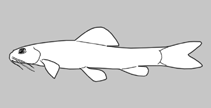
combination of characters: 6-7 black saddles, each continued on both flanks forming a broad diamond-shaped black bar with narrow ventral margins; bars superimposed on a grey stripe along lateral line; numerous melanophores arranged densely on the upper lip ; black basicaudal bar arc-shaped; complete lateral line; processus dentiformis broad; prominent oar-like suborbital flap in males (Ref. 95580).
Body shape (shape guide): elongated.
Inhabits cool, clean, swift-flowing shaded freshwater streams which flow over a substrate of gravel, cobble and boulders. Topotypic specimens were collected from a stream among small pebbles in slow current. Occurs together with other fish species including Cyprinidae: Barilius ngawa, Devario acquipinnatus, Neolissochilus stracheyi, Poropuntius burtoni, Garra paralissorhynchus; Psilorhynchidae: Psilorhynchus ngathanu; Nemacheilidae: Schistura khugae, S. reticulata; Sisoridae: Glyptothorax granulus, G. ventrolineatus; Mastacembelidae: Mastacembelus armatus; and Channidae: Channa gachua (Ref. 95580).
Cycle de vie et comportement reproducteur
Maturité | Reproduction | Frai | Œufs | Fécondité | Larves
Shangningam, B., Y. Lokeshwor and W. Vishwanath, 2014. Schistura phamhringi, a new stone loach from Chindwin basin in Manipur, India (Cypriniformes: Nemacheilidae). Zootaxa 3786(2):181-191. (Ref. 95580)
Statut dans la liste rouge de l'IUCN (Ref. 130435: Version 2025-2 (Global))
Menace pour l'homme
Harmless
Utilisations par l'homme
Outils
Articles particuliers
Télécharger en XML
Sources Internet
Estimations basées sur des modèles
Indice de diversité phylogénétique (Réf.
82804): PD
50 = 0.5000 [Uniqueness, from 0.5 = low to 2.0 = high].
Bayesian length-weight: a=0.00708 (0.00323 - 0.01553), b=3.03 (2.86 - 3.20), in cm total length, based on LWR estimates for this Genus-body shape (Ref.
93245).
Niveau trophique (Réf.
69278): 3.0 ±0.3 se; based on size and trophs of closest relatives
Résilience (Réf.
120179): Milieu, temps minimum de doublement de population : 1,4 à 4,4 années (Preliminary K or Fecundity.).
Vulnérabilité de la pêche (Ref.
59153): Low vulnerability (10 of 100).
🛈