分類 / 名稱
俗名 | 同種異名 | Catalog of Fishes(屬, 種) | ITIS | CoL | WoRMS | Cloffa
Teleostei >
Siluriformes (Catfishes)
鯰形目 (Catfishes) >
Plotosidae (Eeltail catfishes)
鰻鯰科 (Eeltail catfishes)
Etymology: Tandanus: A local name, tandan, in Australia; tropicanus: Named in reference to the region of northeastern Australia that represents the species’ range.
環境: 環境 / 氣候帶 / 深度上下限 / 配送範圍
生態學
; 淡水 居於水底的.
Oceania: Australia from coastal rivers within the wet tropics region of northeast Queensland, including the Daintree, Mulgrave-Russell, Johnstone, Tully, and Five Mile drainage basins.
大小 / 重量 / 年齡
成熟度: Lm ? range ? - ? cm
Max length : 39.5 cm SL 雄魚/尚未辨別雌雄; (Ref. 96080)
簡短描述
檢索表 | 型態特徵 | 形態測量圖
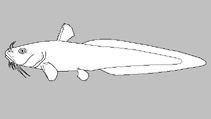
背的軟條 (總數) : 5 - 6; 臀鰭軟條: 150 - 165. Tandanus tropicanus is distinguished from its congener T. tandanus from different drainages. In the Murray-Darling drainage, it differs from T. tandanus by having the following characters: 150-165, mode 156 rays in the continuous caudodorsal and anal fins (vs. 136-149, mode 143); 31-35, mode 31, gill rakers on the first arch (vs. 24-30, mode 28); interorbital width 32.9-38.4% of HL mean 36.2% (vs. 40.3-47.7%, mean 43.5%); pectoral spine 11.1-14.0% of SL, mean 12.4% (vs. 8.9-11.2%, mean 10.1%). For individuals >20.5 cm SL, T. tropicanus can be diagnosed from T. tandanus of the Murray-Darling drainage by having 12-19 (mode 14) posterior serrae on the pectoral-fin spine (vs. 7-11, mode 9). Also, individuals >7.0 cm HL, T. tropicanus differs from T. tandanus of the Murray-Darling drainage by having the following characters: length of the inner mandibular barbel 32.3-41.0% of HL, mean 36.1% (vs. 40.9-54.7%, mean 46.7%); distance between bases of outer mandibular barbels 27.4-33.8% of HL, mean 29.6% (vs. 21.2-25.9%, mean 24.4%); distance between bases of inner mandibular barbels 13.5-15.9% of HL, mean 14.8% (vs. 10.4-13.2%, mean 12.0%); distance between bases of maxillary barbels 47.0-53.5% of HL, mean 50.1% (vs. 39.5-46.6%, mean 44.2% ); maximum cleithral width 75.6-81.4% of HL, mean 78.2% (vs. 68.6-75.2%, mean 71.9%); and eye diameter 14.7-17.2% of HL, mean 15.6% (vs. 12.3-14.6%, mean 13.6%).
In the eastern coastal drainages of Australia (Burnett, Tweed, Brisbane, Fitzroy, Clarence, Mary, and Richmond), Tandanus tropicanus differs from T. tandanus by having the following features: 150-165 rays (mode 156) in the continuous caudodorsal and anal fins (vs. 132-147, mode 145); gill rakers on the first arch 31-35, mode 31 (vs. 27-30, mode 28); interorbital width 32.9-38.4% of HL, mean 36.2% (vs. 40.2-47.3%, mean 43.2%); and to a lesser degree, a longer pectoral spine (11.1-14.0% of SL, mean 12.4% vs. 10.0-11.1%, mean 10.5%, respectively). For individuals >20.5 cm SL, T. tropicanus differs from T. tandanus by having more posterior serrae on the pectoral-fin spine (range 12-19, mode 14 vs. 7-11, mode 10).
Tandanus tropicanus can be differentiated from Bellinger catfish by having a larger eye diameter (14.7-18.5% of HL, mean 16.3% vs. 13.2-14.4%, mean 13.8%, respectively), a longer pectoral spine (11.1-14.0% of SL, mean 12.4% vs. 9.8-10.7%, mean 10.4%, respectively) and, to a lesser degree, fewer gill rakers on the first arch (range 31-35, mode 31 vs. 35-39, respectively). It is distinct from T. bostocki by a shorter post-orbital distance (37.4-42.7% of HL, mean 39.5% vs. 46.7-55.9%, mean 51.9%, respectively), a longer snout (44.1-52.3% of HL, mean 48.9% vs. 37.6-42.1%, mean 39.8%, respectively), and, to a lesser degree, a larger eye diameter (14.7-18.5% of HL, mean 16.3% vs. 11.9-15.5%, mean 13.3%, respectively), more rays in the continuous caudodorsal and anal fins (range 150-165, mode 156 vs. 139-149, mode 147, respectively), more gill rakers on the first arch (range 31-35, mode 31 vs. 18-22, mode 21, respectively), and prominent (vs. reduced) posterior serrae on the pectoral-fin spine, respectively (Ref. 96080).
Inhabits coastal rivers (Ref. 96080).
生命週期和交配行為
成熟度 | 繁殖 | 產卵場 | 卵 | 孕卵數 | 仔魚
Welsh, S.A., D.R. Jerry and D.W. Burrows, 2014. A new species of freshwater eel-tailed catfish of the genus Tandanus (Teleostei: Plotosidae) from the wet tropics region of Eastern Australia. Copeia 2014(1):136-142. (Ref. 96080)
IUCN 瀕危狀態 (Ref. 130435: Version 2025-2 (Global))
無危 (LC) ; Date assessed: 13 February 2019
人類使用
工具
特別的報告
下載 XML
網路資源
基於模型的估計
系統發育多樣性指數 (參考文獻
82804): PD
50 = 0.5625 [Uniqueness, from 0.5 = low to 2.0 = high].
Bayesian length-weight: a=0.00724 (0.00299 - 0.01755), b=3.09 (2.89 - 3.29), in cm total length, based on LWR estimates for this (Sub)family-body shape (Ref.
93245).
營養階層 (參考文獻
69278): 3.5 ±0.6 se; based on size and trophs of closest relatives
回復力 (參考文獻
120179): 中等的, 族群倍增時間最少 1.4 - 4.4年 (Preliminary K or Fecundity.).
釣魚的脆弱性 (Ref.
59153): Moderate vulnerability (38 of 100).
🛈