>
Cypriniformes (Carps) >
Cyprinidae (Minnows or carps) > Labeoninae
Etymology: Stenorynchoacrum: Sten is derived from Green stenos, means narrow; ryncho from Greek rhynchos, means snout; and from Greek acr, means the extremities of the body (snout, ears or trotters). Thus, rynchoacrum means ventral margin of rostral cap. Stenorynchoacrum alludes to the narrow and undeveloped rostral cap of this genus; xijiangensis: Name alludes Xi Jiang, the drainage of the type locality.
Milieu: milieu / Klimaatzone / Diepte / verspreidingsgebied
Ecologie
; zoet water benthopelagisch. Subtropical
Asia: Xiangsi Jiang, a tributary of Li Jiang draining to Xi Jiang of Zhu Jiang Drainage (Pearl River Drainage) in Guangxi Province, China.
Grootte / Gewicht / Leeftijd
Maturiteit: Lm ? range ? - ? cm
Max length : 8.3 cm SL mannelijk / geslacht onbekend; (Ref. 95674)
Korte beschrijving
Determinatiesleutels | Morfologie | Morfometrie
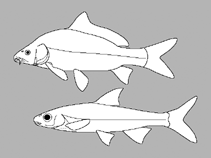
Dorsale zachte stralen (totaal) : 11; Anale zachte stralen: 8; Wervels: 35 - 37. Stenorynchoacrum xijiangensis differs from all species belonging to Labeoninae by the following characters: middle part of rostral cap undeveloped, narrow, only covering the base of the upper jaw, both sides of rostral cap well developed and extending upward, rostral cap connected the lower lip, both lateral part of which free, as the result of a long postlabial groove separating the posterior margin of lateral part of lower lip and the isthmus, the median part of lower lip protrudes to form a round fleshy pad, whose posterior margin continuous with the mental region, no crescentic fold surrounding the fleshy pad (Fig. 2). Other diagnostic characters include: ventral margin of rostral cap unfringed, upper lip regresses to form a row of thin, tiny lobes adnated to upper jaw, the posterior margin of lower jaw connected the anterior part of lower lip, lower lip well developed, variable papillae scattered on rostral cap and lower lip, the anterior margin of upper and lower jaws born flexible, cornified sheath, two pairs of barbels, pharyngeal teeth in 3 rows, and dorsal fin with eight branched rays (Ref. 95674).
Inhabits underground caves connected to the surface river in the Karst area. Remains in
the underground caves in the dry season and swims upward into the rivers during the flood season (Ref. 95674).
Levenscyclus en paargedrag
Maturiteit | Voortplanting | Paaien | Eieren | Fecunditeit | Larven
Huang, Y., J. Yang and X. Chen, 2014. Sternorynchoacrum xijiangensis, a new genus and a new species of Labeoninae fish from Guangxi, China (Teleostei: Cyprinidae). Zootaxa 3793(3):379-386. (Ref. 95674)
Status op de Rode Lijst van het IUCN (Ref. 130435: Version 2025-2 (Global))
Gevaar voor de mens
Harmless
Gebruik door de mens
Tools
Speciale rapporten
Download XML
Internetbronnen
Schattingen op basis van modellen
Fylogenetische diversiteitsindex (Ref.
82804): PD
50 = 1.0000 [Uniqueness, from 0.5 = low to 2.0 = high].
Bayesian length-weight: a=0.00933 (0.00435 - 0.02001), b=3.05 (2.88 - 3.22), in cm total length, based on LWR estimates for this (Sub)family-body shape (Ref.
93245).
Weerstandsvermogen (Ref.
120179): Hoog, minimale populatieverdubbelingstijd minder dan 15 maanden (Preliminary K or Fecundity.).
Kwetsbaarheid van de visserij (Ref.
59153): Low vulnerability (10 of 100).
🛈