Clasificación / Nombres
Nombres comunes | Sinónimos | Catalog of Fishes(Género, Especie) | ITIS | CoL | WoRMS | Cloffa
>
Beloniformes (Needle fishes) >
Zenarchopteridae (Internally fertilized halfbeaks)
Etymology: Nomorhamphus: Greek, nema = filament + Greek, rhamphos = bill, peak (Ref. 45335); sagittarius: From the Latin sagittarius, meaning archer, in allusion to the body shape of the new species, reminiscent of the shape of an arrow. A noun in apposition.
Entorno: milieu / zona climática / rango de profundidad / gama de distribución
Ecología
; agua dulce pelágico; rango de profundidad 0 - ? m. Tropical
Asia: Mangola River basin (Sungai Mangolo, Sungai Tawo-Tawo and Sungai Watumbasi) in Sulawesi Tenggara, Indonesia.
Tamaño / Peso / Edad
Madurez: Lm ? range ? - ? cm
Max length : 4.3 cm SL macho / no sexado; (Ref. 97329); 7.3 cm SL (female)
Descripción breve
Claves de identificación | Morfología | Morfometría
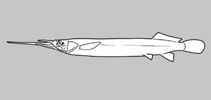
Radios blandos dorsales (total) : 11 - 13; Radios blandos anales: 14 - 17; Vértebra: 37 - 39. Nomorhamphus sagittarius can be diagnosed from all congeners by the following combination of characters: lower jaw elongated; one to seven teeth along dorsal surface of extended portion of lower jaw (absent in some specimens); fins and ventral surface of lower jaw orange; absence of black fin pigmentation; base of the pectoral fin with a distinct black spot; a lanceolate, dorsally slightly curved spiculus in the male andropodium, its middle segments in contact with the distal tip of the third anal-fin ray; seven to ten segments proximal to spinae (mode eight); segments three to seven (mode three to five) of second anal-fin ray in males with a dorsal and a ventral row of ‘subsegments’ forming small squares and rectangles of different sizes, so that these segments seem to be subdivided; second anal-fin ray with an elongated fourth or fifth segment (mode fifth) in some males (78.6% of the adult male type specimens); and third anal-fin ray slightly constricted longitudinally, giving the appearance of two distinct rays, distal part of this ray is slightly curved ventrally to contact spiculus (Ref. 97329).
Collected from three streams (Sungai Mangolo, Sungai Tawo-Tawo and Sungai Watumbasi) in Sulawesi Tenggara, Indonesia. There are two sampling sites for Sungai Mangolo: one is about 6-8 m wide and 10-100 cm deep with a sandy and rocky bottom and clear water at the type locality near the Scout Camping Ground of the Forestry Department area; and the other one is about 5-7 m wide, 10-50 cm deep and moderate running with a few boulders and stones at this point, is covered by rain forest canopy and with murky water due to traditional gold mining in the area. Sungai Tawo-Tawo is about 3-5 m wide and 10-50 cm deep at the sample site and characterized by a sandy and gravel bottom and by clear water with much riparian vegetation. The Sungai Watumbasi is 1-3 m wide, 10-30 cm deep and characterized by a muddy-sandy bottom (Ref. 97329).
Ciclo vital y comportamiento de apareamiento
Madurez | Reproducción | Puesta | Huevos | Fecundidad | Larva
Huylebrouck, J., R.K. Hadiaty and F. Herder, 2014. Two new species of viviparous halfbreaks (Atherinomorpha: Beloniformes: Zenarchopteridae) endemic to Sulawesi Tenggara, Indonesia. Raffles Bulleting of Zoology 62:200-209. (Ref. 97329)
Situación en la Lista Roja de la UICN (Ref. 130435: Version 2025-2 (Global))
Amenaza para el ser humano
Harmless
Usos humanos
Pesquerías: sin interés
Herramientas
Informes especiales
Descargar XML
Fuentes de Internet
Estimaciones basadas en modelos
Índice de diversidad filogenética (Referencia
82804): PD
50 = 0.5000 [Uniqueness, from 0.5 = low to 2.0 = high].
Bayesian length-weight: a=0.00457 (0.00198 - 0.01053), b=3.03 (2.83 - 3.23), in cm total length, based on LWR estimates for this (Sub)family-body shape (Ref.
93245).
Nivel trófico (Referencia
69278): 3.1 ±0.4 se; based on size and trophs of closest relatives
Vulnerabilidad pesquera (Ref.
59153): Low vulnerability (10 of 100).
🛈