Classificazione / Nomi
Nomi Comuni | Sinonimi | Catalog of Fishes(Genere, Specie) | ITIS | CoL | WoRMS | Cloffa
>
Beloniformes (Needle fishes) >
Adrianichthyidae (Ricefishes) > Oryziinae
Etymology: Oryzias: Greek, oryza = rice; because of the habitat used by this fish (Ref. 45335); soerotoi: Named for Bambang Soeroto, a systematic ichthyologist at Sam Ratulangi University, Indonesia, in recognition of his enduring contributions to the exploration of fish diversity in Sulawesi.
Eponymy: H R Bambang Soeroto (1929 –2021) was a systematic ichthyologist who was also professor (1986) of geomorphology in the Department of Biology at Sam Ratulangi University, Indonesia. [...] (Ref. 128868), visit book page.
Ambiente: milieu / zona climatica / distribuzione batimetrica / gamma di distribuzione
Ecologia
; acqua dolce benthopelagico. Tropical
Asia: Lake Tiu in central Sulawesi, Indonesia.
Dimensione / Peso / Età
Maturità: Lm ? range ? - ? cm
Max length : 2.9 cm SL maschio/sesso non determinato; (Ref. 103734); 3.2 cm SL (female)
Breve descrizione
Chiavi di identificazione | Morfologia | Morfometria
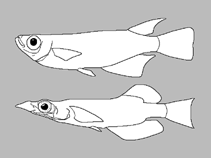
Raggi dorsali molli (totale) : 8 - 9; Raggi anali molli: 18 - 21; Vertebre: 29 - 31. Oryzias soerotoi is distinguished from all congeners from Sulawesi by its brilliant orange coloration in the dorsal and ventral margins of the caudal fins of adult males. It differs by fewer scales along lateral midline (30-32) from O. sarasinorum (70-75), O. bonneorum (36-39), O. eversi (33-36), O. orthognathus (45-57), O. nigrimas (34-37), and O. matanensis (41-47). Other character useful to identify O. soerotoi is by having deeper body depth (21.6-24.8 vs. 13-15 in O. sarasinorum; and 17-20 in O. bonneorum). In addition, O. soerotoi has narrower body than O. matanensis (26.0-31.0) and O. profundicola (30.4-35.2); fewer dorsal-fin rays (8-9) than O. sarasinorum (11-12), O. bonneorum (12-13), O. eversi (10-12), and O. profundicola (10-14); fewer vertebrae (29-31) than O. sarasinorum (34), O. orthognathus (33), and O. nigrimas (32-33). It can be diagnosed from O. matanensis, O. marmoratus, O. profundicola, and O. hadiatyae, by the absence of dark brown blotches or bars on the lateral body in adult males. It can be further distinguished by its shorter anal-fin base (23.7-29.7) from O. marmoratus (31.4-36.9) and O. profundicola (37.4-41.4). It is distinct from O. hadiatyae by its short head (21.9-24.9 versus 27.2-37.1) and no pronounced concavity on the snout; from O. celebensis by the absence of distinct black stripes from the posterior midbody onto the caudal fin and of diffuse dark bars extended from dorsal and ventral to the midline; further from O. celebensis by having somewhat fewer pectoral-fin rays (9-10 vs. 10-11); from O. woworae, O. wolasi, and O. asinua by the absence of steel blue body coloration and of brilliant red or orangish coloration in the dorsal and ventral margins of the caudal peduncle; and larger size than O. woworae, O. wolasi, and O. asinua (up to 3.21 cm SL vs. 2.86 cm SL); from O. nebulosus by having a truncate caudal fin (vs. emarginate) and somewhat fewer lateral scales (30-32 vs. 32-36). It differs from O. mekongensis and O. pectoralis, Oryzias outside of Sulawesi having orange or reddish margins on the caudal fins of males by the possession of 8-9 dorsal-fin rays (vs. 5-7 in O. mekongensis and 6-7 in O. pectoralis) and attaining larger size (up to 1.67 cm SL in O. mekongensis and 2.23 cm SL in O. pectoralis) (Ref. 103734).
Body shape (shape guide): elongated.
The type locality, Lake Tiu in central Sulawesi, is surrounded by trees and mountains and
is characterized by a muddy substrate, and calm and transparent water, but darkly stained by decaying vegetation. Juveniles and young fish occurs in shallow habitats with dense vegetation (Ref. 103734).
Ciclo vitale e comportamento di accoppiamento
Maturità | Riproduzione | Deposizione | Uova | Fecondità | Larve
Based on aquarium observations, females carry eggs on a genital pore for several hours and deposit them onto submerged yarn (Ref. 103734).
Mokodongan, D.F., R. Tanaka and K. Yamahira, 2014. A new ricefish of the genus Oryzias (Beloniformes, Adrianichthyidae) from Lake Tiu, Central Sulawesi, Indonesia. Copeia 2014(3):561-567. (Ref. 103734)
Stato della Lista Rossa IUCN (Ref. 130435: Version 2025-2 (Global))
Minaccia per l'uomo
Harmless
Usi umani
Pesca: di nessun interesse
Strumenti
Rapporti speciali
Scarica XML
Fonti Internet
Stime basate su modelli
Indice di diversità filogenetica (Fonte Biblio.
82804): PD
50 = 0.5000 [Uniqueness, from 0.5 = low to 2.0 = high].
Bayesian length-weight: a=0.00479 (0.00190 - 0.01207), b=3.13 (2.91 - 3.35), in cm total length, based on LWR estimates for this (Sub)family-body shape (Ref.
93245).
Livello trofico (Fonte Biblio.
69278): 3.3 ±0.4 se; based on size and trophs of closest relatives
Vulnerabilità della pesca (Ref.
59153): Low vulnerability (10 of 100).
🛈