Clasificación / Nombres
Nombres comunes | Sinónimos | Catalog of Fishes(Género, Especie) | ITIS | CoL | WoRMS | Cloffa
>
Siluriformes (Catfishes) >
Schilbeidae (Schilbid catfishes)
Etymology: Eutropiichthys: Greek, eutropheia = well fed + Greek, ichthys = fish (Ref. 45335); cetosus: Derived from Latin adjective cetus, meaning a large sea animal (commonly referred to as whale), in allusion to the numerous gill rakers of this species, which are reminiscent of baleen in baleen whales.
Entorno: milieu / zona climática / rango de profundidad / gama de distribución
Ecología
; agua dulce demersal; rango de profundidad 1 - 4 m (Ref. 96851). Tropical
Asia: Kaladan River drainage in southern Mizoram, India.
Tamaño / Peso / Edad
Madurez: Lm ? range ? - ? cm
Max length : 12.8 cm SL macho / no sexado; (Ref. 96851)
Descripción breve
Claves de identificación | Morfología | Morfometría
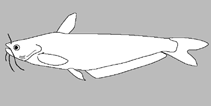
Espinas dorsales (total) : 2; Radios blandos dorsales (total) : 7; Radios blandos anales: 48 - 54; Vértebra: 49 - 52. Eutropiichthys cetosus is distinguished from all congeners, with the exception of E. burmannicus by the possession of more rakers 25-35 (vs. 15-20) on the first gill arch. It can be diagnosed from E. burmannicus by having moderately rounded snout in lateral view (vs. distinctly pointed in E. burmannicus) and slightly trilobed in dorsal view (vs. acutely angular in E. burmannicus), a deeper head relative to its length (68.7-77.1% HL vs. 65.4-67.5% HL), fewer branched rays on pectoral fin (13-15 vs. 15-17, rarely 15), and a more slender body (depth at dorsal-fin origin 19.2-23.5% SL vs. 23.7-25.3% SL; depth at anal-fin origin 17.5-23.5% SL vs. 23.2-26.3% SL). It further differs from congeners by the following unique combination of characters: 49-52 total vertebrae, fleshy narial flap not extending medially much past medial margin of naris, mouth rictus reaching vertical through middle of orbit, rough anterior edge of pectoral spine, 43-49 branched anal-fin rays, and caudal peduncle depth 7.8-8.6 % SL (Ref. 96851).
Body shape (shape guide): elongated.
Found in a clear, slow and moderate flowing river with a depth of 1-4 m (Ref. 96851).
Ciclo vital y comportamiento de apareamiento
Madurez | Reproducción | Puesta | Huevos | Fecundidad | Larva
Ng, H.H., Lalramliana, S. Lalronunga and Lalnuntluanga, 2014. Eutropiichthys cetosus, a new riverine catfish (Teleostei: Schilbeidae) from Northeastern India. J. Threat. Taxa 6(8):6073-6081. (Ref. 96851)
Situación en la Lista Roja de la UICN (Ref. 130435: Version 2025-2 (Global))
Amenaza para el ser humano
Harmless
Usos humanos
Herramientas
Informes especiales
Descargar XML
Fuentes de Internet
Estimaciones basadas en modelos
Índice de diversidad filogenética (Referencia
82804): PD
50 = 0.5078 [Uniqueness, from 0.5 = low to 2.0 = high].
Bayesian length-weight: a=0.00550 (0.00251 - 0.01205), b=3.06 (2.87 - 3.25), in cm total length, based on LWR estimates for this (Sub)family-body shape (Ref.
93245).
Nivel trófico (Referencia
69278): 3.3 ±0.5 se; based on size and trophs of closest relatives
Resiliencia (Referencia
120179): Alto, población duplicada en un tiempo mínimo inferior a 15 meses (Preliminary K or Fecundity.).
Vulnerabilidad pesquera (Ref.
59153): Low vulnerability (10 of 100).
🛈