Klassificering / Namn
Populärnamn | synonymer | Catalog of Fishes(Släkte, Arter) | ITIS | CoL | WoRMS | Cloffa
>
Siluriformes (Catfishes) >
Loricariidae (Armored catfishes) > Hypoptopomatinae
Etymology: alicula: From the Latin alicula, diminutive of ala, wing, fin in case of a fish, in allusion to the short pectoral fin diagnostic of the species. A noun in apposition.
Miljö: miljö / Klimatzon / djupintervall / distributionsområde
Ekologi
; sötvatten bottenlevande. Tropical
South America: Rio Santo Antônio basin, a tributary to Rio Sapucaí, itself a tributary to the upper Rio Grande, Rio Paraná basin in Brazil.
Storlek / Vikt / Ålder
Könsmognad: Lm ? range ? - ? cm
Max length : 3.6 cm SL hane/ej könsbestämd; (Ref. 96503)
Kort beskrivning
Bestämningsnycklar | Morfologi | Morfometri
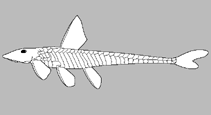
Taggstrålar i ryggfenan (totalt) : 2; Mjukstrålar i ryggfenan (totalt) : 7; Taggstrålar i analfenan: 1; Mjukstrålar i analfenan: 5; Ryggkotor: 29 - 30. The possession of the unique caudal-fin coloration pattern, consisting of a densely pigmented blotch occupying its proximal half, prolonged posteriorly onto the middle rays but not reaching the posterior border of fin distinguishes Otothyropsis alicula from other species of Otothyropsis (vs. various color patterns but never with a distinct proximal blotch). It further differs from O. marapoama, O. piribebuy, and O. biamnicus by having a shorter prepelvic length (33.9-37.7 vs. 40.6-45.4, 42.2-46.3, and 36.7-39.3% SL, respectively), and from males of O. polyodon (33.9-36.3, mean 5 35.9 vs. 36.2-39.5% SL, mean 5 37.9). It can be further diagnosed from all congeners, except O. polyodon, by having the dorsal-fin spinelet rectangular in shape (vs. dorsal fin-spinelet triangular or quadrangular). It can be distinguished from all its congeners, except O. piribebuy, by having a raised crest of enlarged odontodes in the posterior portion of the parieto-supraocciptal (vs. such crest present). It also differs from O. marapoama, O. piribebuy, and O. polyodon by having the abdomen devoid or almost devoid of plates (vs. abdomen totally covered by plates or with three to four lateral abdominal plates and a row or few platelets in posterior portion of abdomen); shorter pectoral-fin spine (16.5-20.0 vs. 25.2-30.5, 24.9-30.4, and 21.4-26.9% SL, respectively), and the sutures between contiguous neural spines extending two-thirds the distance from centra to distal portion (vs. sutures between neural spines extending from near centra to or almost to the distal tip); from O. marapoama and O. piribebuy by having 11-13 plates between anal and caudal fins (vs. 9-10 plates, in both), complete median series of lateral plates, reaching to the caudal fin (vs. the medial series of lateral plates truncated at least two plates before the caudal fin), and 22-25 plates in median lateral series (vs. 17-21 and 19-20, respectively); from O. polyodon by having larger cleithral width (22.6-24.7 vs. 19.2-21.9%SL) and shorter nares diameter (6.8-11.2 vs. 11.5-15.6% HL); and from O. biamnicus by having a longer snout (49.7-54.2 vs. 44.1-47.9% HL) (Ref. 96503).
Livscykel och parningsbeteende
Könsmognad | Reproduktion | Lek | Ägg | Fekunditet | Larver
Lippert, B.G., B.B. Calegari and R.E. Reis, 2014. A new species of Otothyropsis (Siluriformes: Hypoptopomatinae) from Eastern Brazil. Copeia 2014(2):238-244. (Ref. 96503)
Status på IUCN:s rödlista (Ref. 130435: Version 2025-2 (Global))
Hot mot människor
Harmless
Mänskliga användningsområden
Verktyg
Särskilda rapporter
Ladda ner XML
Internet-källor
Uppskattningar baserade på modeller
Index för fylogenetisk mångfald (Ref.
82804): PD
50 = 0.5156 [Uniqueness, from 0.5 = low to 2.0 = high].
Bayesian length-weight: a=0.00977 (0.00434 - 0.02202), b=3.06 (2.87 - 3.25), in cm total length, based on LWR estimates for this (Sub)family-body shape (Ref.
93245).
Trofisk nivå (Ref.
69278): 2.3 ±0.1 se; based on size and trophs of closest relatives
Resiliens (Ref.
120179): Hög, lägsta populationsfördubblingstid mindre än 15 månader (Preliminary K or Fecundity.).
Sårbarhet i fisket (Ref.
59153): Low vulnerability (10 of 100).
🛈