التصنيف / الأسماء
الأسماء الشائعة | مرادفات | Catalog of Fishes(جنس, الانواع) | ITIS | CoL | WoRMS | Cloffa
>
Cyprinodontiformes (Rivulines, killifishes and live bearers) >
Aphaniidae (Oriental killifishes)
Etymology: marassantensis: Derived from Marassanta, the Hittite name for the Kızılırmak River. An adjective.
البيئة: الوسط / المنطقة المناخية / نطاق العمق / نطاق التوزيع
البيئة
; المياه العذبة قاعية التغذية و المعيشة. Temperate
Asia: Kızılırmak drainage in Turkey.
الحجم / وزن / العمر
النضج: Lm ? range ? - ? cm
Max length : 3.8 cm SL ذكر/ مختلط الجنس; (Ref. 98396); 5.5 cm SL (female)
وصف مختصر
مفاتيح التعريف | الوصف الخارجي | قياسات المظهر الخارجي
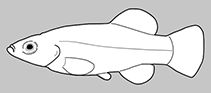
الأشعة الظهرية الناعمة (المجموع) : 9 - 11; أشعه شرجية لينه: 9 - 11; فقرات: 25 - 27. Aphanius marassantensis, previously included in A. danfordii, is distinctly separated from A. danfordii and congeners from Anatolia by 11 fixed, diagnostic nucleotide substitutions in the mtDNA COI barcode region. Males larger than 2.6 cm SL differ from male A. danfordii by having narrower dark-brown lateral bars (antepenultimate bar anterior to caudal-fin base 0.9-1.8 times wider than the anterior white interspace vs. 2.3-4.0); most males larger than 2.6 cm SL have an ovoid dorsal profile (vs. an always rhomboid dorsal profile, which is straight up to a vertical line from the pelvic-fin origin in A. danfordii). Females larger than 3.0 cm SL can be differentiated from A. danfordii females by the lack of vertical rows of dark-brown spots on the caudal and anal fins (vs. 2-3 narrow rows of dark-brown spots, 1-2 rows in the anterior part of anal fin, proximal to the anal-fin base), and 1-3 lateral rows of large dark-brown spots on the flank behind a vertical from the dorsal-fin origin (vs. flank with equally spaced dark-brown spots not organized in rows). Some females of A. danfordii also lack rows of dark-brown spots in the anal and caudal fins. Since the color pattern on the body of these specimens was faded, it is suspected that the spots on the fins too, might have faded away.
Aphanius marassantensis is distinguished from A. saldae by having a less slender and elongated body shape (Body depth/Standard length 28.2-39.6% vs. 20.1-21.3%), body with complete scale cover (vs. scales absent on back and belly), and 25-28 scales along the lateral series (vs. 47-51). It can be diagnosed from A. anatoliae, A. fontinalis, A. iconii, A. maeandricus, A. meridionalis, A. sureyanus, A. transgrediens and A. villwocki by the color pattern of male and female. Male A. marassantensis has 8-13 dark-brown lateral bars (vs. 6-7 and 7) than A. meridionalis and A. sureyanus, has 2-3 vertical rows of spots on the caudal fin (vs. 5-6), and mostly has 8-13 lateral bars (vs. 13-19) than A. villwocki). They further differ from A. iconii and A. maeandricus by the coloration of the dorsal fin consisting of black, sometimes with narrow whitish-grey base (vs. black with a wide proximal white band and black with large white blotches or a white band), and from A. fontinalis by the coloration of the anal fin composed of white with 1-3 rows of black spots, sometimes with a black margin (vs. black with a white base). Aphanius marassantensis is distinct from A. transgrediens by having a hyaline pelvic fins ( vs. fully or partially black), and narrower dark-brown lateral bars than A. anatoliae larger than 2.6 cm SL (third-last bar anterior to caudal-fin base 0.9-1.8 times wider than the anterior white interspace vs. 2.1-4.3).
Female A. marassantensis is distinguished from A. sureyanus and A. villwocki by the presence of many dark-brown spots on the flanks (vs. irregular large dark-brown blotches and an almost complete absence of spots), and from A. sureyanus by the coloration of the dorsal fin (hyaline with tiny dark-brown spots on rays and membranes vs. hyaline with few tiny dark-brown spots only on rays). Female A. marassantensis larger than 2.8 cm SL differ from A. iconii by 1-3 lateral rows of large dark-brown spots on flank behind dorsal-fin base (vs. irregularly set brown blotches and spots), and from A. anatoliae and A. meridionalis by having hyaline caudal fin (vs. 1-4 and 1-3 rows of dark-brown spots). They can be further differentiated from A. maeandricus and A. transgrediens by having a single prominent large dark-brown blotch in mid-lateral position on hypural plate (vs. spot in mid-lateral position on hypural plate of comparable size to spots on the flank), and from A. fontinalis by the coloration of the pectoral fins and the anal and caudal fins (hyaline vs. hyaline with black spots) (Ref. 98396).
Body shape (shape guide): fusiform / normal.
Inhabits a wide range of freshwater habitats, ranging from springs and small streams to large dam lakes (Ref. 98396).
دورة الحياة وسلوك التزاوج
النضج | التكاثر | وضع البيض | بيض | الخصوبة | اليرقات
Pfleiderer, S.J., M.F. Geiger and F. Herder, 2014. Aphanius marassantensis, a new toothcarp from the Kızılırmak drainage in northern Anatolia (Cyprinodontiformes: Cyprinodontidae). Zootaxa 3887(5):569-582. (Ref. 98396)
حالة القائمة الحمراء للاتحاد الدولي لحفظ الطبيعة والموارد الطبيعية (Ref. 130435: Version 2025-2 (Global))
استخدامات بشرية
أدوات
تقارير خاصة
تنزيل XML
مصادر علي الأنترنت
تقديرات تستند إلى النماذج
مؤشر التنوع الشُعبي الوراثي (مرجع
82804): PD
50 = 0.5001 [Uniqueness, from 0.5 = low to 2.0 = high].
Bayesian length-weight: a=0.01288 (0.00847 - 0.01960), b=3.33 (3.21 - 3.45), in cm total length, based on LWR estimates for this species & Genus-body shape (Ref.
93245).
مستوى غذائي (مرجع
69278): 2.9 ±0.4 se; based on size and trophs of closest relatives
المرونه (مرجع
120179): عالي, الحد الزمني الأدني لتضاعف عدد أفراد المجتمع أقل من 15 شهر (Preliminary K or Fecundity.).
ضعف الصيد (Ref.
59153): Low vulnerability (10 of 100).
🛈