Classificatie / Namen
Lokale namen | Synoniemen | Catalog of Fishes(Genus, Soort(en)) | ITIS | CoL | WoRMS | Cloffa
>
Cypriniformes (Carps) >
Nemacheilidae (Brook loaches)
Etymology: Paraschistura: Generic name taken from its similarity with the genus Schistura; abdolii: Named after Ashgar Abdoli, an Iranian fish ecologist who collected this species together with J. Freyhof in 2007. A noun in genitive, indeclinable.
Eponymy: Dr Asghar Abdoli is an Iranian fish ecologist who collected this species together with Jörg Freyhof (2007). [...] (Ref. 128868), visit book page.
Milieu: milieu / Klimaatzone / Diepte / verspreidingsgebied
Ecologie
; zoet water demersaal. Subtropical
Asia: three drainage basins in southern Iran: Kol drainage, Sirjan basin and western tributaries of the Hamun-e Jaz Murian basin.
Grootte / Gewicht / Leeftijd
Maturiteit: Lm ? range ? - ? cm
Max length : 6.6 cm SL mannelijk / geslacht onbekend; (Ref. 103390)
Korte beschrijving
Determinatiesleutels | Morfologie | Morfometrie
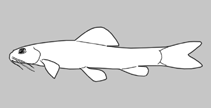
Paraschistura abdolii is distinguished from its congeners in Iran by a combination of following non-unique characters: deeply embedded and often isolated scales on the caudal peduncle and, in some populations, present immediately in front of the dorsal-fin origin (vs. body scaleless in P. turcmenica and P. kessleri) and a color pattern of 11-19 regularly or irregularly shaped pale- or dark-brown bars, often dissociated into a marmorate pattern (vs. 10-12 distinct, regularly shaped and set dark-brown bars in P. kessleri); absence of scales on the back, or scales on the back present only in front of the dorsal-fin origin (vs. back fully covered by scales in P. bampurensis and P. nielseni) and by the absence of a suborbital flap or groove in males (vs. suborbital flap present in P. bampurensis, suborbital groove present in P. nielseni); very slender body (vs. stout in P. nielseni); absence of a dorsal adipose keel (vs. presence in from P. cristata) or if a keel is present, by the absence of procurrent rays in the keel (vs. presence in from P. cristata); and an incomplete lateral line (vs. complete in from P. cristata) (Ref. 103390). Materials examined from the Hamun-e Jaz Murian and Sirjan basins lack scales on the back, which is also the case in most specimens from the Kol drainage. Some individuals from Kol drainage have scales on the back, immediately in front of
the dorsal-fin origin (Ref. 103390).
Sympatric with Paraschistura naumanni in the Kol drainage (Ref. 103390).
Levenscyclus en paargedrag
Maturiteit | Voortplanting | Paaien | Eieren | Fecunditeit | Larven
Freyhof, J., G. Sayyadzadeh, H.R. Esmaeili and M. Geiger, 2015. Review of the genus Paraschistura from Iran with description of six new species (Teleostei: Nemacheilidae). Ichthyol. Explor. Freshwat. 26(1):1-48. (Ref. 103390)
Status op de Rode Lijst van het IUCN (Ref. 130435: Version 2025-2 (Global))
Gevaar voor de mens
Harmless
Gebruik door de mens
Tools
Speciale rapporten
Download XML
Internetbronnen
Schattingen op basis van modellen
Fylogenetische diversiteitsindex (Ref.
82804): PD
50 = 0.5000 [Uniqueness, from 0.5 = low to 2.0 = high].
Bayesian length-weight: a=0.00646 (0.00337 - 0.01237), b=2.92 (2.76 - 3.08), in cm total length, based on LWR estimates for this species & Genus-body shape (Ref.
93245).
Trofisch niveau (Ref.
69278): 2.8 ±0.3 se; based on size and trophs of closest relatives
Weerstandsvermogen (Ref.
120179): Gemiddeld, minimale populatieverdubbelingstijd 1,4-4,4 jaar (Preliminary K or Fecundity.).
Kwetsbaarheid van de visserij (Ref.
59153): Low vulnerability (10 of 100).
🛈