Classificazione / Nomi
Nomi Comuni | Sinonimi | Catalog of Fishes(Genere, Specie) | ITIS | CoL | WoRMS | Cloffa
>
Cypriniformes (Carps) >
Nemacheilidae (Brook loaches)
Etymology: Paraschistura: Generic name taken from its similarity with the genus Schistura; pasatigris: Named for Pasatigris, the ancient name of the Karun River where the type material was collected. Pas in Sanskrit means to 'touch' or to be 'bound to'. This refers to the fact that the Karun is an independent drainage but closely bound to the Tigris. A noun in apposition.
Taxonomic Remarks
This species is synonym of Paraschistura ilamensis Vatandoust and Eagderi, 2015 according to Jouladeh-Roudbar et al. (2015: Ref. 106319:888). To be confirmed.
Ambiente: milieu / zona climatica / distribuzione batimetrica / gamma di distribuzione
Ecologia
; acqua dolce demersale. Subtropical
Asia: Bala River (Balarud) and the Cholvar River, two tributaries of the Dez in the Karun
drainage and from the Siah Gav in the Karkheh drainage in Iran.
Dimensione / Peso / Età
Maturità: Lm ? range ? - ? cm
Max length : 4.5 cm SL maschio/sesso non determinato; (Ref. 103390)
Breve descrizione
Chiavi di identificazione | Morfologia | Morfometria
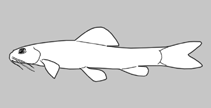
Paraschistura pasatigris can be diagnosed from its congeners in Iran by a combination of the following non-unique characters: a suborbital flap present in males (vs. absent in P. aredvii and a suborbital groove in P. nielseni); more slender caudal peduncle (caudal peduncle depth 1.6-1.8 times longer than deep vs. 1.1-1.4 in P. nielseni); back and flank in front of the dorsal-fin origin fully covered by scales (vs. absence of scales on the back and on the flank in front of the dorsal-fin origin in P. abdolii and P. cristata; and scales completely absent in P. kessleri and P. turcmenica); absence of a long dorsal adipose crest (vs. presence in P. cristata); pelvic-fin origin behind a vertical through the dorsal-fin origin (vs. below or slightly in front in P. naumanni). It is distinguished from P. bampurensis and P. hormuzensis by having a pointed suborbital flap in males overlapping the slit below the lachrymal bone (vs. triangular, not overlapping the slit) and a blunt snout (vs. pointed). It differs also from P. abdolii, P. cristata, P. kessleri, P. naumanni and P. turcmenica by the presence of a suborbital flap in males (vs. absence) (Ref. 103390).
Body shape (shape guide): elongated.
Ciclo vitale e comportamento di accoppiamento
Maturità | Riproduzione | Deposizione | Uova | Fecondità | Larve
Freyhof, J., G. Sayyadzadeh, H.R. Esmaeili and M. Geiger, 2015. Review of the genus Paraschistura from Iran with description of six new species (Teleostei: Nemacheilidae). Ichthyol. Explor. Freshwat. 26(1):1-48. (Ref. 103390)
Stato della Lista Rossa IUCN (Ref. 130435: Version 2025-2 (Global))
Minaccia per l'uomo
Harmless
Usi umani
Strumenti
Rapporti speciali
Scarica XML
Fonti Internet
Stime basate su modelli
Indice di diversità filogenetica (Fonte Biblio.
82804): PD
50 = 0.5000 [Uniqueness, from 0.5 = low to 2.0 = high].
Bayesian length-weight: a=0.00617 (0.00318 - 0.01197), b=2.91 (2.75 - 3.07), in cm total length, based on LWR estimates for this species & Genus-body shape (Ref.
93245).
Livello trofico (Fonte Biblio.
69278): 2.8 ±0.3 se; based on size and trophs of closest relatives
Resilienza (Fonte Biblio.
120179): Alto, tempo minimo di raddoppiamento della popolazione meno di 15 mesi (Preliminary K or Fecundity.).
Vulnerabilità della pesca (Ref.
59153): Low vulnerability (10 of 100).
🛈