Clasificación / Nombres
Nombres comunes | Sinónimos | Catalog of Fishes(Género, Especie) | ITIS | CoL | WoRMS | Cloffa
>
Cyprinodontiformes (Rivulines, killifishes and live bearers) >
Rivulidae (Rivulines) > Cynolebiinae
Etymology: Garcialebias: Named for Dr Graciela García and the Greek, 'lebias'; araucarianus: Name refers to the presence of this new species in the Aracaurian Plateau Forest, a temperate biogeographical province, in which the landscape is dominated by the Brazilian conifer Araucaria angustifolia.
Entorno: milieu / zona climática / rango de profundidad / gama de distribución
Ecología
; agua dulce bentopelágico. Temperate
South America: Iguaçu river drainage, Paraná river basin in Brazil.
Tamaño / Peso / Edad
Madurez: Lm ? range ? - ? cm
Max length : 3.5 cm SL macho / no sexado; (Ref. 97355); 3.1 cm SL (female)
Descripción breve
Claves de identificación | Morfología | Morfometría
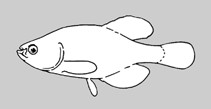
Radios blandos dorsales (total) : 18 - 24; Radios blandos anales: 18 - 23; Vértebra: 29. Austrolebias araucarianus can be diagnosed from all congeners by the difference of the color pattern of males and females. The unpaired fins in males consist of yellowish grey bars parallel to fins rays on basal and middle portion, sometimes with transverse connections. Females have dark spots on trunk which are vertically elongated, often forming short bars. It can be further separated from other species of Austrolebias by having rudimentary or the absence of pelvic and pelvic-fin girdle (vs. well-developed, except in two specimens of A. carvalhoi lacking pelvic fin) and the first three neuromasts of the supraorbital series separated from the remaining neuromasts by an interspace (vs. continuous). It is similar to other species of the subgenus Acrolebias (A. carvalhoi and A. varzeae) and differs from species of the subgenera Cypholebias and Megalebias by having 9 gill rakers on the ventral portion of the first branchial arch (vs. 11-16); 17-22 neuromasts around the orbit (vs. 23-38); 2-3 neuromasts on the otic series (vs. 4-10), and preopercular and mandibular series of neuromasts separated (vs. united), and from species of Cypholebias by having shorter pectoral-fin in males extending to the urogenital papilla (vs. reaching between bases of 2nd and 6th anal-fin rays). It also differs from A. carvalhoi and A. varzeae by having 31-33 scales in the longitudinal series (vs. 27-29 in A. carvalhoi and 28-30 in A. varzeae) and 12-14 neuromasts in the supraorbital series (vs. 17-18). It can be separated also from A. varzeae and all species of the subgenera Cypholebias and Megalebias by having 23-25 caudal-fin rays (vs. 28-29 in A. varzeae, 26-32 in species of Cypholebias and 29-36 in Megalebias) and frontal squamation G-pattern (vs. F-patterned in A. varzeae and species of Cypholebias, and irregularly arranged in Megalebias) (Ref. 97355).
Body shape (shape guide): elongated.
Occurs in a shallow seasonal swamp, within a forest in the floodplains of a tributary to the Iguaçu river, at an altitude of about 785 m. At the time of sampling on 21 September, the swamp was about 40 cm deep with clear, pale yellow water (Ref. 97355).
Ciclo vital y comportamiento de apareamiento
Madurez | Reproducción | Puesta | Huevos | Fecundidad | Larva
Costa, W.J.E.M., 2014. Austrolebias araucarianus, a new seasonal killifish from the Iguaçu river drainage, southern Brazilian Araucarian Plateau Forest (Cyprinodontiformes: Rivulidae). Ichthyol. Explor. Freshwat. 25(2):97-101. (Ref. 97355)
Situación en la Lista Roja de la UICN (Ref. 130435: Version 2025-2 (Global))
Amenaza para el ser humano
Harmless
Usos humanos
Pesquerías: sin interés
Herramientas
Informes especiales
Descargar XML
Fuentes de Internet
Estimaciones basadas en modelos
Índice de diversidad filogenética (Referencia
82804): PD
50 = 0.5000 [Uniqueness, from 0.5 = low to 2.0 = high].
Bayesian length-weight: a=0.00617 (0.00266 - 0.01427), b=3.13 (2.93 - 3.33), in cm total length, based on LWR estimates for this (Sub)family-body shape (Ref.
93245).
Nivel trófico (Referencia
69278): 3.1 ±0.4 se; based on size and trophs of closest relatives
Resiliencia (Referencia
120179): Alto, población duplicada en un tiempo mínimo inferior a 15 meses (Preliminary K or Fecundity.).
Vulnerabilidad pesquera (Ref.
59153): Low vulnerability (10 of 100).
🛈