>
Gobiiformes (Gobies) >
Gobiidae (Gobies) > Gobiinae
Etymology: Cryptocentrus: Greek, kryptos = hidden + Greek, kentron = sting (Ref. 45335).
Milieu: milieu / Klimaatzone / Diepte / verspreidingsgebied
Ecologie
marien benthopelagisch; diepte 1 - 10 m (Ref. 90102). Tropical
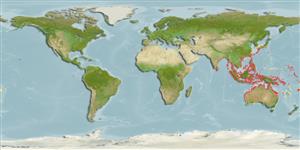
East indian Ocean to Western Pacific: Andaman Sea to Papua New Guinea and Palau; north to Yaeyama Islands and throughout the East Indian region.
Grootte / Gewicht / Leeftijd
Maturiteit: Lm ? range ? - ? cm
Max length : 10.0 cm TL mannelijk / geslacht onbekend; (Ref. 90102)
Korte beschrijving
Determinatiesleutels | Morfologie | Morfometrie
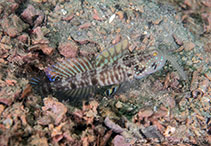
Dorsale stekels (totaal) : 7; Dorsale zachte stralen (totaal) : 10; Anale stekels: 1; Anale zachte stralen: 9. This species is characterized by the following: D VI + !,10; A I,9; pectoral fin-rays 16-18; pelvic fin united , frenum present; longitudinal scales 75-82; head no scales; greatest body depth 4.1-5.2 in SL; caudal fin rounded, longer than head length; variable coloration ranging from yellow to mainly dark brown; diffuse bars on side; a pair of large, distinct dark-brown streaks above rear corner of the mouth and a second pair on gill cover; blue streaks on pelvic, anal and caudal fins. The yellow or yellowish brown variety has the same head markings (usually fainter), blue spots on the head, pale saddles across top of head and back; blue streaks on yellow pelvic and anal fins. The dark variety have similar head markings to pale and yellow varieties, but mainly dark brown body with several pale saddles across the back. All varieties have short bar across upper pectoral-fin base (Ref. 90102).
Body shape (shape guide): elongated; Cross section: oval.
Inhabits sand-silt bottoms (Ref. 90102); associated with alpheid shrimps (Ref. 96641).
Levenscyclus en paargedrag
Maturiteit | Voortplanting | Paaien | Eieren | Fecunditeit | Larven
Allen, G.R. and M.V. Erdmann, 2012. Reef fishes of the East Indies. Perth, Australia: Universitiy of Hawai'i Press, Volumes I-III. Tropical Reef Research. (Ref. 90102)
Status op de Rode Lijst van het IUCN (Ref. 130435: Version 2025-2 (Global))
Gevaar voor de mens
Harmless
Gebruik door de mens
Tools
Speciale rapporten
Download XML
Internetbronnen
Schattingen op basis van modellen
Gewenste temperatuur (Ref.
123201): 26.7 - 29.3, mean 28.7 °C (based on 1817 cells).
Fylogenetische diversiteitsindex (Ref.
82804): PD
50 = 0.5000 [Uniqueness, from 0.5 = low to 2.0 = high].
Bayesian length-weight: a=0.00741 (0.00347 - 0.01582), b=3.09 (2.91 - 3.27), in cm total length, based on LWR estimates for this (Sub)family-body shape (Ref.
93245).
Trofisch niveau (Ref.
69278): 3.3 ±0.4 se; based on size and trophs of closest relatives
Weerstandsvermogen (Ref.
120179): Hoog, minimale populatieverdubbelingstijd minder dan 15 maanden (Preliminary K or Fecundity.).
Kwetsbaarheid van de visserij (Ref.
59153): Low vulnerability (10 of 100).
🛈