Classification / Noms
Noms communs | Synonymes | Catalog of Fishes(Genre, Espèce) | ITIS | CoL | WoRMS | Cloffa
>
Scombriformes (Mackerels) >
Trichiuridae (Cutlassfishes) > Lepidopodinae
Etymology: Evoxymetopon: Greek, eu = good + Greek, oxys = sharpen + Greek, metopon = brow (Ref. 45335); moricheni: Named for Mordechai (‘Mori’) Chen, who first discovered the species (holotype) while diving in the Gulf of Aqaba.
Eponymy: Mordechai ‘Mori’ Chen discovered this species while snorkeling in the Gulf of Aqaba. He found the (dead) holotype, at first imagining the long, shiny object to be a strip of metal. (Ref. 128868), visit book page.
Environnement : milieu / zone climatique / profondeur / gamme de distribution
Écologie
marin benthopélagique. Tropical
Indian Ocean: Red Sea.
Taille / Poids / Âge
Maturité: Lm ? range ? - ? cm
Max length : 83.0 cm SL mâle / non sexé; (Ref. 95272)
Description synthétique
Clés d'identification | Morphologie | Morphométrie
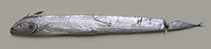
Rayons mous dorsaux (Total) : 83; Vertèbres: 88. This species is distinguished by the following set of characters: convex upper head profile; the posterior confluence of frontal ridges slightly elevated at the nape that a slight sagittal crest is seen; crescent-shaped nostril; eye 5.2 times in HL; lower hind margin of the opercle is slightly pointed in its lower half; pelvic fins, reduced to scale-like structure, soft rays 2 on the posterior process of the basipterygium, its origin below the eighth dorsal-fin element; first anal spine single, oval, scale like, and originating a short distance behind the vent (opposite the 34th dorsal-fin soft ray); externally visible around 17 anal-fin rays; approximately 83 dorsal-fin elements, with first spine not elongated and shorter than second; pectoral-fin rays 12 (ii + 6 + iv), with shorter anterior (fourth ray shortest) and longer posterior rays extending above the lateral line; upper gill rakers of the first arch 9; vent located at about 49 % TL; total vertebrae 88; horizontal distance between posterior margin of the eye and origin of the first dorsal-fin spine very short (2 % HL); PL 51.1 % TL; HL
29.7 % PL; upper jaw length 11.6 % PL; predorsal length 20.3 % PL; head and body silver white, with a blackish margin anteriorly on the snout and head, continuing along the anterior half of the dorsal-fin base (Ref. 95272).
Body shape (shape guide): eel-like; Cross section: compressed.
Cycle de vie et comportement reproducteur
Maturité | Reproduction | Frai | Œufs | Fécondité | Larves
Fricke, R., D. Golani and B. Appelbaum-Golani, 2014. Evoxymetopon moricheni, a new cutlassfish from the northern Red Sea (Teleostei: Trichiuridae). Ichthyol. Res. 61(3):293-297. (Ref. 95272)
Statut dans la liste rouge de l'IUCN (Ref. 130435: Version 2025-2 (Global))
Menace pour l'homme
Harmless
Utilisations par l'homme
Outils
Articles particuliers
Télécharger en XML
Sources Internet
Estimations basées sur des modèles
Indice de diversité phylogénétique (Réf.
82804): PD
50 = 0.5625 [Uniqueness, from 0.5 = low to 2.0 = high].
Bayesian length-weight: a=0.00054 (0.00022 - 0.00129), b=3.13 (2.92 - 3.34), in cm total length, based on LWR estimates for this (Sub)family-body shape (Ref.
93245).
Niveau trophique (Réf.
69278): 4.2 ±0.7 se; based on size and trophs of closest relatives
Résilience (Réf.
120179): Milieu, temps minimum de doublement de population : 1,4 à 4,4 années (Preliminary K or Fecundity.).
Vulnérabilité de la pêche (Ref.
59153): High vulnerability (61 of 100).
🛈