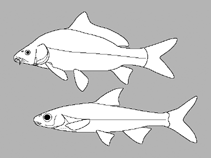
klasifikasi / Nama
Nama-nama umum | Sinonim (persamaan) | Catalog of Fishes(Marga, Jenis) | ITIS | CoL | WoRMS | Cloffa
>
Cypriniformes (Carps) >
Cyprinidae (Minnows or carps) > Cyprininae
Etymology: Sinocyclocheilus: Latin, sino, sina = from China + Greek, kyklos = circle + Greek, cheilos = lip (Ref. 45335); brevifinus: Derived from the Latin brevis, meaning short and latinized 'fin' as finus, in reference to the short fins of this species. A noun in apposition.
Lingkungan: lingkungan / zona iklim / kisaran kedalaman / jangkauan distribusi
Ekologi
; air tawar bentopelagis. Subtropical
Asia: subterranean river at Maohedong Village in Guangxi, China.
Ukuran / Berat / umur
Kematangan: Lm ? range ? - ? cm
Max length : 11.1 cm SL jantan/; (Ref. 97526)
deskripsi pendek
Kunci identifiaksi (pengenalan) | Morfologi | Morfometrik
duri punggung lunak (Keseluruhan (total)) : 10; Sirip dubur lunak: 8; vertebrata, bertulang belakang: 35 - 38. Sinocyclocheilus brevifinus is distinguished from many congeners in having the following characters: presence of eyes; nape not elevated to form a slight, moderate, or strongly developed hump; notably absence of any anteriorly directed rounded or blunt, unifed or bifed projections from nape or posterior part of cranium. It can be diagnosed from all other similar congeners, except S. jii, S. guilinensis, S. huangtianensis, S. gracilis, S. yishanensis and S. macrolepis, by having the last dorsal unbranched rays soft, absence of serrations along the posterior margin of last dorsal unbranched soft ray (vs. serrated in other species). It differs from S. macrolepis in having scales of lateral line significantly larger than those in scale rows immediately above and below lateral line (vs. of nearly same size); from S, yishanensis in having 46-48 lateral-line scale rows (vs. 57-69); from S, jii, S. huangtianensis and S. guilinensis in having smaller eye diameter (3.4-5.0% SL vs. 5.7-8.6% SL), shorter dorsal fin (distal tip of depressed dorsal fin not reaching vertical from origin of anal fin vs. terminal reaching or beyond origin of anal fin), shorter pelvic fin (depressed fin far from the anus-fin 15.0-17.8% SL vs. reaching anus-fin 17.4-20.2% SL) and short maxillary barbels (tip of barbels not reaching edge of operculum vs. extending beyond edge of operculum). It differs further from S. jii in having more gill rakes (9-12 vs. 6-7), from S. guilinensis in having more scales around caudal peduncle (44-46 vs. 34-36), and from S. huangtianensis in having fewer lateral-line scale rows (46-48 vs. 52-59). It can be differentiated from S. gracilis in having more circumpeduncular scale rows of 44-46 (vs. 36-38), a shorter caudal peduncle (19.1-22.9% vs. 27.6-31.2% SL), shorter head (23.0-27.3% SL vs. 27.6-31.2% SL), and presence of black spots on flanks (vs. absence) (Ref. 97526).
Body shape (shape guide): elongated.
Occurs only in underground river system. Collected together with Silurus cochinchinensis and Zacco platypus (Ref. 97526)
Siklus hidup dan perilaku kawin
Kematangan | Reproduksi, perkembang biakan | Pemijahan | telur-telur | Fekunditas | Larva
Li, J., X. Li and R.L. Mayden, 2014. Sinocyclocheilus brevifinus (Teleostei: Cyprinidae), a new species of cavefish from Guangxi, China. Zootaxa 3873(1):37-48. (Ref. 97526)
Status IUCN Red List (Ref. 130435: Version 2025-2 (Global))
ancaman kepada manusia
Harmless
penggunaan manusia
Alat, peralatan
laporan khas
muat turun XML
Sumber internet
Estimasi berdasarkan model
Indeks keanekaragaman filogenetik (Acuan
82804): PD
50 = 0.5000 [Uniqueness, from 0.5 = low to 2.0 = high].
Bayesian length-weight: a=0.00646 (0.00298 - 0.01397), b=3.09 (2.90 - 3.28), in cm total length, based on LWR estimates for this (Sub)family-body shape (Ref.
93245).
Tingkat Trofik (Acuan
69278): 2.9 ±0.3 se; based on size and trophs of closest relatives
Daya lenting (Acuan
120179): Tinggi, Waktu penggandaan populasi minimum kurang dari 15 bulan (Preliminary K or Fecundity.).
Kerentanan Penangkapan Ikan (Ref.
59153): Low vulnerability (10 of 100).
🛈