Classification / Noms
Noms communs | Synonymes | Catalog of Fishes(Genre, Espèce) | ITIS | CoL | WoRMS | Cloffa
>
Siluriformes (Catfishes) >
Loricariidae (Armored catfishes) > Hypoptopomatinae
Etymology: Chauliocheilos: Derived from a combination of the Greek chaulios (conspicuous, outstanding, prominent), and cheilos (lip), in reference to the labial appendix; saxatilis: From the Latin adjective saxatilis, meaning that lives on rocks, in reference to the microhabitat where the species is mainly collected. An adjective.
Environnement : milieu / zone climatique / profondeur / gamme de distribution
Écologie
; eau douce démersal. Tropical
South America: headwaters of rio Itamarandiba, upper rio Jequitinhonha drainage in southeastern Brazil.
Taille / Poids / Âge
Maturité: Lm ? range ? - ? cm
Max length : 4.9 cm SL mâle / non sexé; (Ref. 98819)
Description synthétique
Clés d'identification | Morphologie | Morphométrie
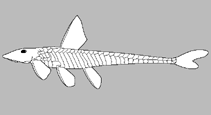
Rayons mous dorsaux (Total) : 8 - 9; Rayons mous anaux: 6 - 7; Vertèbres: 31. Chauliocheilos saxatilis is distinguished from all species of the Loricariidae by its unique labial appendix at laterodorsal portion of lower lip, associated to the proximal region of insertion of the maxillary barbel, in females above 3.24 cm SL and in males above 3.0 cm SL, but always much more developed in males, in which the appendix is highly grooved and can be very elongated posteriorly, surpassing the anterior portion of pectoral girdle. It differs further from all members of Hypoptopomatinae by the possession of 2 additional series of lateral plates on the body, one between the dorsal and mid-dorsal series with 2 to 16 plates, and the other between the mid-ventral and ventral series with 2 to 11 plates. Additional characters useful to identify this species within Hypoptopomatinae include the high number of lateral plates, mainly in the mid-dorsal (25-39) and mid-ventral series (28-41), lack of iris operculum, and the insertion of dorsal-fin posterior in the body, with the anterior portion of compound supraneural plus first dorsal-fin proximal radial contacting the neural spine of eighth vertebra (Ref. 98819).
Body shape (shape guide): elongated.
The type locality is a very small stream, about 1 m wide, up to 30 cm deep, with a bottom consisting of gravel, pebbles, sand and clay, and besides trees and shrubs, with its margins composed of many specimens of Hedychium sp. (Zingiberaceae). This species was collected mostly in the bottom but also associated with vegetation at the margins. Other fishes found in the same stream include Astyanax fasciatus, Rhamdia cf. quelen, Rhamdiopsis sp., Trichomycterus jequitinhonhae and Trichomycterus sp. Based on four specimens ranging from 4.10-4.75 cm SL, food items in the stomach were mainly fine particulate organic matter and periphyton (unicellular algae, diatoms, zooplankton and microcrustaceans) (Ref. 98819).
Cycle de vie et comportement reproducteur
Maturité | Reproduction | Frai | Œufs | Fécondité | Larves
Martins, F.O., B.N. Andrade, A.C. Rosa and F. Langeani, 2014. Chauliocheilos saxatilis, a new genus and species of Hypoptopomatinae from rio Jequitinhonha basin, with a unique labial appendix (Teleostei: Loricariidae). Ichthyol. Explor. Freshwat. 25(3):193-204. (Ref. 98819)
Statut dans la liste rouge de l'IUCN (Ref. 130435: Version 2025-2 (Global))
Menace pour l'homme
Harmless
Utilisations par l'homme
Pêcheries: sans intérêt
Outils
Articles particuliers
Télécharger en XML
Sources Internet
Estimations basées sur des modèles
Indice de diversité phylogénétique (Réf.
82804): PD
50 = 1.0000 [Uniqueness, from 0.5 = low to 2.0 = high].
Bayesian length-weight: a=0.00977 (0.00434 - 0.02202), b=3.06 (2.87 - 3.25), in cm total length, based on LWR estimates for this (Sub)family-body shape (Ref.
93245).
Résilience (Réf.
120179): Haut, temps minimum de doublement de population inférieur à 15 mois (Preliminary K or Fecundity.).
Vulnérabilité de la pêche (Ref.
59153): Low vulnerability (10 of 100).
🛈