Klassifizierung / Names
Namen | Synonyme | Catalog of Fishes(Gattung, Arten) | ITIS | CoL | WoRMS | Cloffa
>
Siluriformes (Catfishes) >
Loricariidae (Armored catfishes) > Hypoptopomatinae
Etymology: Neoplecostomus: Greek, neos = new + Greek, plekos,-eos = twisted (Ref. 45335); doceensis: The specific name is a Latin noun which means being located or having connection with the rio Doce basin.
Umwelt: Milieu / Klimazone / Tiefenbereich / Verbreitungsgebiet
Ökologie
; süßwasser demersal. Tropical
South America: Rio Doce Basin in Minas Gerais State, Brazil.
Größe / Gewicht / Alter
Geschlechtsreife: Lm ? range ? - ? cm
Max length : 10.1 cm SL Männchen/unbestimmt; (Ref. 106072)
Kurzbeschreibung
Bestimmungsschlüssel | Morphologie | Morphometrie
Rückenflossenstacheln (insgesamt) : 2; Rückenflossenweichstrahlen (insgesamt) : 7; Afterflossenstacheln: 1; Afterflossenweichstrahlen: 5. Neoplecostomus doceensis can be distinguished from all its congeners by the presence of enlarged, fleshy folds between dentaries in all specimens, more evident in mature males (vs. absence of the enlarged fleshy folds). It also differs from all congeners by the presence of two or three series of well-developed papillae anterior to premaxillary teeth (vs. papillae poorly developed or absent). Other characters useful for its identification from other congeners include: presence of a fully-developed adipose fin (vs. lacking or reduced adipose fin in N. botucatu and N. paranensis); moderately-sized odontodes along lateral margins of snout and snout without swollen skin in mature males (vs. presence of large-sized odontodes surrounded by swollen skin along lateral margins of snout in mature males of N. selenae); a well-developed dorsal-fin spinelet, wider than dorsal-fin spine base (vs. absent or narrower than dorsal-fin spine base in N. franciscoensis and N. ribeirensis); 12-35 dentary teeth (vs. 5-12 in N. microps and 7 in N. variipictus); 25-29 lateral-line plates (vs. 34-43 in N. granosus); presence of a developed membrane on the dorsal portion of the first, second and third pelvic-fin branched rays (vs. absence in N. langeanii) (Ref. 106072).
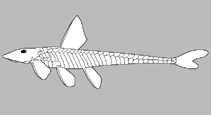
Body shape (shape guide): elongated.
Inhabits clear water rivers, varying from small to medium sized, with rocky outcrops forming small waterfalls and substrates of rocks and sand. Occurs at the bottom of the rivers among the rocks (Ref. 106072).
Lebenszyklus und Paarungsverhalten
Geschlechtsreife | Fortpflanzung | Ablaichen | Eier | Fruchtbarkeit | Larven
Roxo, F.F., G.S.C. Silva, C.H. Zawadzki and C. Oliveira, 2014. Neoplecostomus doceensis: a new loricariid species (Teleostei, Siluriformes) from the rio Doce basin and comments about its putative origin. ZooKeys 440:115-127. (Ref. 106072)
IUCN Rote Liste Status (Ref. 130435: Version 2025-2 (Global))
Bedrohung für Menschen
Harmless
Nutzung durch Menschen
Tools
Zusatzinformationen
Download XML
Internet Quellen
Schätzungen auf der Grundlage von Modellen
Phylogenetischer Diversitätsindex (Ref.
82804): PD
50 = 0.5000 [Uniqueness, from 0.5 = low to 2.0 = high].
Bayesian length-weight: a=0.00977 (0.00434 - 0.02202), b=3.06 (2.87 - 3.25), in cm total length, based on LWR estimates for this (Sub)family-body shape (Ref.
93245).
Widerstandsfähigkeit (Ref.
120179): hoch, Verdopplung der Population dauert weniger als 15 Monate. (Preliminary K or Fecundity.).
Anfälligkeit der Fischerei (Ref.
59153): Low vulnerability (10 of 100).
🛈