Elasmobranchii (haaien en roggen) (sharks and rays) >
Carcharhiniformes (Ground sharks) >
Scyliorhinidae (Cat sharks) > Scyliorhininae
Etymology: Scyliorhinus: skylion, Greek for dogfish or small shark; rhinus, from rhine (Gr.), rasp, alluding to a shark’s jagged, rasp-like skin (See ETYFish); ugoi: In honor of Ugo de Luna Gomes, son of the third author (See ETYFish).
Eponymy: Ugo de Luna Gomes is the son of the third author, the Brazilian ichthyologist Ulisses Leite Gomes (q.v.). (Ref. 128868), visit book page.
Milieu: milieu / Klimaatzone / Diepte / verspreidingsgebied
Ecologie
marien demersaal; diepte 400 - 500 m (Ref. 101269). Tropical; 5°S - 17°S, 37°W - 39°W (Ref. 101269)
Southwest Atlantic: Brazil.
Grootte / Gewicht / Leeftijd
Maturiteit: Lm ? range ? - ? cm
Max length : 53.4 cm TL mannelijk / geslacht onbekend; (Ref. 101269); 63.0 cm TL (female)
Korte beschrijving
Determinatiesleutels | Morfologie | Morfometrie
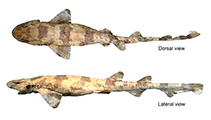
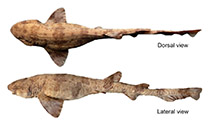
This species is distinguished by the following characters: head considerably broad (vs. slender in the S. haeckelii/besnardi group and S. hesperius); with brown saddles on a light brown background, predorsal saddles with anterior and posterior sharp median projections (vs. no projections in the S. haeckelii/besnardi group or S. hesperius) and light and dark, spiracle-sized or slightly smaller spots, no large white spots (vs. large white spots in S. hesperius); also, the snout is rounded and moderately short, preoral length 5% TL (vs. 4.5% TL in the S. haeckelii/besnardi group); preorbital length 6.4% TL and head length 20% TL (vs. 5% TL and 18% TL in S. hesperius); mouth width 9% TL (vs. 8% TL in the S. haeckelii/besnardi group and 7.2% TL in S. hesperius); pectoral-pelvic space 1.5 times pelvic-anal space (vs. equal in the S. haeckelii/besnardi group), and interdorsal space 2.3 times dorsal-caudal space (vs. 1.6 times in S. haeckelii/besnardi group); anal-fin base 8% TL (vs. 6.7% TL in S. hesperius, 8.3% TL in the S. haeckelii/besnardi group); cranium with flat basal plate, without keels; cranial width larger in females 42.7% NL (vs. 37.4% NL in S. haeckelii/besnardi group); with a terminal dermal cover in hindmost portion of clasper, covering terminal cartilages (none in S. hesperius); medium-sized, adult male at 44.5 cm TL and adult female 50.0 cm TL (vs. 35.3 cm and 41.0 cm, respectively, for the S. haeckelii/besnardi group) (Ref. 101269).
Cross section: angular.
Recorded specimens are mostly demersal, about 400-500 m deep, and associated with coral formations, where it possibly lays its egg-cases. Stomach contents consist of small invertebrates (cephalopods), small bony fishes, and one hagfish (Class Myxini) egg-case which was found in the stomach of an adult specimen. The size at first maturity is not well defined, but 45.0 cm TL males and 47.0 cm TL females are adults. Reproduction is by oviparity, with at least two amber colored egg capsules (one for each uterus) which are smooth, lacking longitudinal grooves and measuring about 15.2 cm long and 5.8 cm wide (Ref. 101269).
Levenscyclus en paargedrag
Maturiteit | Voortplanting | Paaien | Eieren | Fecunditeit | Larven
Soares, K.D.A., O.F.B. Gadig and U.L. Gomes, 2015. Scyliorhinus ugoi, a new species of catshark from Brazil (Chondrichthyes: Carcharhiniformes: Scyliorhinidae). Zootaxa 3937(2):347-361. (Ref. 101269)
Status op de Rode Lijst van het IUCN (Ref. 130435: Version 2025-2 (Global))
Gevaar voor de mens
Harmless
Gebruik door de mens
Tools
Speciale rapporten
Download XML
Internetbronnen
Schattingen op basis van modellen
Fylogenetische diversiteitsindex (Ref.
82804): PD
50 = 0.5000 [Uniqueness, from 0.5 = low to 2.0 = high].
Bayesian length-weight: a=0.00269 (0.00140 - 0.00518), b=3.21 (3.04 - 3.38), in cm total length, based on LWR estimates for this (Sub)family-body shape (Ref.
93245).
Trofisch niveau (Ref.
69278): 3.9 ±0.5 se; based on size and trophs of closest relatives
Weerstandsvermogen (Ref.
120179): laag, minimale populatieverdubbelingstijd 4,5-14 jaar (Preliminary low fecundity).
Kwetsbaarheid van de visserij (Ref.
59153): Moderate to high vulnerability (45 of 100).
🛈