Пластиножаберные (акулы и скаты) (sharks and rays) >
Squaliformes (Sleeper and dogfish sharks) >
Etmopteridae (Lantern sharks)
Etymology: Etmopterus: Greek, ethmos, -ou = sieve or ethmoides bone + Greek, pteron = wing, fin (Ref. 45335); benchleyi: Named for Peter Benchley, author of the movie Jaws and subsequently an avid shark conservationist.
Eponymy: Peter Benchley (1940–2006) was an American author and screenwriter, best known for writing Jaws (1974). [...] (Ref. 128868), visit book page.
Окружающая среда: среда / климатическая зона / пределы глубины / диапазон распространения
экология
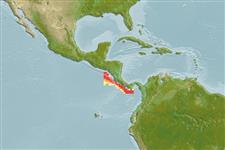
морской pelagic-oceanic; пределы глубины 836 - 1443 m (Ref. 106129). Deep-water; 13°N - 6°N, 89°W - 80°W (Ref. 106129)
Eastern Pacific Ocean: from Nicaragua south to Panama.
Размер / Вес / Возраст
половая зрелость: Lm ? range ? - ? cm
Max length : 32.5 cm TL самец/пол неопределен; (Ref. 106129); 51.5 cm TL (female)
Краткое описание
определительные ключи | морфология | морфометрия
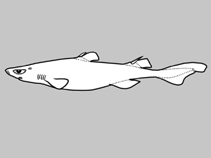
This moderately large species is distinguished by the following set of characters: short snout with pre-narial length 2.9% TL (2.9-4.0%) and pre-oral length 7.8% TL (6.9-9.0%); broad mouth strongly arched, width 1.2 (1.0-1.5) times into pre-oral length; dentition show strong disjunct dignathic heterodonty with upper teeth comprised of single median cusp, flanked by 1-2 pairs of lateral cusplets, where lower teeth with low, distally-inclined cusps lacking serrations and a low posterior blade; dermal denticles are short, slender, with slightly hook-like conical crowns; denticles below second dorsal fin in irregular patch densities and align into rows along the ceratotrichia of the fins; denticles dense around the eyes and gill openings, sparse to bare on ventrum of snout tip and around mouth; first and dorsal fins similar in size; the second-dorsal-fin spine 1.7 (1.6-2.3) times longer than first-dorsal-fin spine; the second-dorsal-fin spine height greater than second-dorsal-fin apex; interdorsal-fin space is moderately long, 23.1% TL (19.2-21.4%); body color uniformly black, the anteroposteriorly oblong narrow pineal window apparent (Ref. 106129)
Body shape (shape guide): elongated; Cross section: angular.
The larger individuals of this species were collected at greater depth than smaller specimens, suggesting a positive relationship between size and depth, as has been observed in E. princeps. The largest paratype (51.5 cm TL) contains five ova ranging from 25.6 to 34.2 mm, with no embryos apparent. The immature male paratype has claspers at the earliest stage of development, suggesting that maturity for males is attained at a greater size. Viviparous with litter sizes apparently consist of at least 5 pups with post-partum lengths less than 177 mm TL (Ref. 106129).
Жизненный цикл и брачное поведение
половая зрелость | размножение | нерест | икра | Плодовитость | личинки
Vásquez, V.E., Ebert. D.A. and D.J. Long, 2015. Etmopterus benchleyi n. sp., a new lanternshark (Squaliformes: Etmopteridae) from the central eastern Pacific Ocean. J. Ocean Sci. Found. 17:43-55. (Ref. 106129)
Статус Красного Списка МСОП (Ref. 130435: Version 2025-2 (Global))
Угроза для людей
Harmless
Использование человеком
рыболовство: интереса не представляет
дополнительная информация
инструменты
Специальные отчеты
Скачать в формате XML
ресурсы в Интернет
Оценки, основанные на моделях
Предпочтительная температура (ссылка
123201): 3.3 - 3.5, mean 3.4 °C (based on 6 cells).
Индекс филогенетического разнообразия (ссылка
82804): PD
50 = 0.5000 [Uniqueness, from 0.5 = low to 2.0 = high].
Bayesian length-weight: a=0.00389 (0.00200 - 0.00755), b=3.08 (2.91 - 3.25), in cm total length, based on LWR estimates for this Genus-body shape (Ref.
93245).
Трофический уровень (ссылка
69278): 4.2 ±0.6 se; based on size and trophs of closest relatives
устойчивость к внешним воздействиям (ссылка
120179): низкий, минимальное время удвоения популяции 4.5-14 лет (Preliminary K or Fecundity.).
Уязвимость рыбной ловли (Ref.
59153): Moderate vulnerability (41 of 100).
🛈