Classificatie / Namen
Lokale namen | Synoniemen | Catalog of Fishes(Genus, Soort(en)) | ITIS | CoL | WoRMS | Cloffa
>
Siluriformes (Catfishes) >
Loricariidae (Armored catfishes) > Hypoptopomatinae
Etymology: Microlepidogaster: Greek, mikros = small + Greek, lepis = scale + Greek, gaster = stomach (Ref. 45335); discus: From the Latin discus, meaning flat circular plate, in reference to the first reduced and round plates in the mid-ventral lateral series, a diagnostic feature of the species. A noun in apposition.
Milieu: milieu / Klimaatzone / Diepte / verspreidingsgebied
Ecologie
; zoet water demersaal. Tropical
South America: Rio Jequitinhonha in southeastern Brazil.
Grootte / Gewicht / Leeftijd
Maturiteit: Lm ? range ? - ? cm
Max length : 4.6 cm SL mannelijk / geslacht onbekend; (Ref. 97523)
Korte beschrijving
Determinatiesleutels | Morfologie | Morfometrie
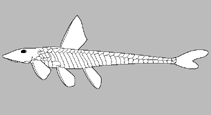
Dorsale zachte stralen (totaal) : 9; Anale zachte stralen: 6; Wervels: 31. Microlepidogaster discus is distinguished from other species of the genus Microlepidogaster by having the following characters: the ventral laminar expansions of cleithrum and coracoid bearing only 1-30 odontodes restricted to the area near the pectoral-fin insertion (vs. 50-120 odontodes, generally more than 100, extending to the middle portion of pectoral girdle); the anterior plates of mid-ventral lateral series reduced, not ventrally elongated, the first or the second markedly round (vs. anterior plates of mid-ventral lateral series large, curved and elongated, similar to most of the other anterior plates of the series); pectoral-fin unbranched ray distinctly divided distally, with 7-15 ossified segments reaching almost half of its length (vs. ossified segments absent, or when present less than seven, restricted to the tip of the ray); and accessory process on first epibranchial present (vs. absent). It differs also from all congeners, except for M. dimorpha, by having the anterior portion of compound supraneural plus first dorsal-fin proximal radial contacting the neural spine of the seventh vertebra (vs. eighth or ninth vertebra in M. perforatus, ninth vertebra in M. arachas, and 10th or 11th vertebra in M. longicolla). It can be diagnosed from M. perforatus and M. dimorpha by having pointed odontodes at the anterior portion of rostral plates (vs. rounded leaf-shaped odontodes); from M. longicolla and M. perforatus by having the mid-dorsal lateral series of plates surpassing the vertical through dorsal-fin length (vs. mid-dorsal lateral series reduced, reaching the vertical through dorsal-fin base, and never surpassing the dorsal-fin length); and from M. perforatus by having the median series of lateral plates complete, reaching the end of the caudal peduncle (vs. median series of lateral plates terminating two plates before the end of the caudal peduncle) and by the presence of an iris operculum (vs. absence) (Ref. 97523).
Body shape (shape guide): elongated.
Facultative air-breathing in the genus (Ref. 126274); Observed to fold their lips longitudinally, partially or totally, with right and left halves, including the barbels, contacting at midline when handled during sampling (Ref. 97523).
Levenscyclus en paargedrag
Maturiteit | Voortplanting | Paaien | Eieren | Fecunditeit | Larven
Martins, F.O., A.C. Rosa and F. Langeani, 2014. Microlepidogaster discus, a new species of Hypoptopomatinae (Siluriformes: Loricariidae) from the rio Jequitinhonha basin, southern Brazil. Zootaxa 3873(5):560-570. (Ref. 97523)
Status op de Rode Lijst van het IUCN (Ref. 130435: Version 2025-2 (Global))
Gevaar voor de mens
Harmless
Gebruik door de mens
Tools
Speciale rapporten
Download XML
Internetbronnen
Schattingen op basis van modellen
Fylogenetische diversiteitsindex (Ref.
82804): PD
50 = 0.5039 [Uniqueness, from 0.5 = low to 2.0 = high].
Bayesian length-weight: a=0.00977 (0.00434 - 0.02202), b=3.06 (2.87 - 3.25), in cm total length, based on LWR estimates for this (Sub)family-body shape (Ref.
93245).
Weerstandsvermogen (Ref.
120179): Hoog, minimale populatieverdubbelingstijd minder dan 15 maanden (Preliminary K or Fecundity.).
Kwetsbaarheid van de visserij (Ref.
59153): Low vulnerability (10 of 100).
🛈