Classification / Noms
Noms communs | Synonymes | Catalog of Fishes(Genre, Espèce) | ITIS | CoL | WoRMS | Cloffa
>
Cypriniformes (Carps) >
Cyprinidae (Minnows or carps) > Barbinae
Etymology: Barbus: Latin, barbus = barbel (Ref. 45335); biharicus: Named for the Bihar Counties (there are counties with this name in both Romania and Hungary), where the species is almost exclusively distributed.
Eponymy: Sir Charles Alfred Payton (1843–1926) was a British adventurer, writer, fisherman and diplomat who was British Consul to Morocco, where this barb is found. [...] (Ref. 128868), visit book page.
Environnement : milieu / zone climatique / profondeur / gamme de distribution
Écologie
; eau douce benthopélagique. Temperate
Europe: Sebes-Körös River, Danube River basin in Hungary and Romania; presumably in Fekete-Körös River (Crişul Negru) and Fehér-Körös River (Crişul Alb).
Taille / Poids / Âge
Maturité: Lm ? range ? - ? cm
Max length : 11.5 cm SL mâle / non sexé; (Ref. 106510)
Description synthétique
Clés d'identification | Morphologie | Morphométrie
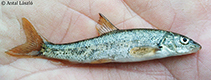
Barbus biharicus can be distinguished by having significantly larger interorbital and preanal distance than B. balcanicus, B. carpathicus and B. petenyi, and significantly deeper head than B. carpathicus and B. petenyi. Compared to these 3 species, it has a tendency to have shorter, rounded snout, slightly longer pectoral fins, but slightly shorter anal fin. It can be further identified by having small dark spots on dorsal region of body and flanks and, to a lesser extent, head, and dark pigments on the fins occasionally form dark spots (the other species have heavy dark spots, which typically are arranged into rows on dorsal and caudal fins) (Ref. 106510).
Body shape (shape guide): elongated.
Cycle de vie et comportement reproducteur
Maturité | Reproduction | Frai | Œufs | Fécondité | Larves
Antal, L., B. László, P. Kotlík, A. Mozsár, I. Czeglédi, M. Oldal, G. Kemenesi, F. Jakab and S.A. Nagy, 2016. Phylogenetic evidence for a new species of Barbus in the Danube River basin. Mol. Phylogenet. Evol. 96:187-194. (Ref. 106510)
Statut dans la liste rouge de l'IUCN (Ref. 130435: Version 2025-2 (Global))
Menace pour l'homme
Harmless
Utilisations par l'homme
Outils
Articles particuliers
Télécharger en XML
Sources Internet
Estimations basées sur des modèles
Indice de diversité phylogénétique (Réf.
82804): PD
50 = 0.5000 [Uniqueness, from 0.5 = low to 2.0 = high].
Bayesian length-weight: a=0.00794 (0.00367 - 0.01719), b=3.05 (2.88 - 3.22), in cm total length, based on LWR estimates for this Genus-body shape (Ref.
93245).
Niveau trophique (Réf.
69278): 3.1 ±0.4 se; based on size and trophs of closest relatives
Résilience (Réf.
120179): Haut, temps minimum de doublement de population inférieur à 15 mois (Preliminary K or Fecundity.).
Vulnérabilité de la pêche (Ref.
59153): Low vulnerability (10 of 100).
🛈