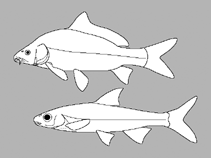
klasifikasi / Nama
Nama-nama umum | Sinonim (persamaan) | Catalog of Fishes(Marga, Jenis) | ITIS | CoL | WoRMS | Cloffa
>
Cypriniformes (Carps) >
Cyprinidae (Minnows or carps) > Smiliogastrinae
Etymology: Enteromius: Greek, enteron = intestine + Greek, myo, mys = muscle (Ref. 45335); validus: Specific name, validus, from the Latin meaning strong or powerful, in reference to the robust appearance of the species (Ref. 106731).
Lingkungan: lingkungan / zona iklim / kisaran kedalaman / jangkauan distribusi
Ekologi
; air tawar bentopelagis. Tropical
Africa: N’sele River and Mayi Ndombe River, Congo River basin in Democratic Republic of the Congo (Ref. 106731), and Léfini River in Congo Republic (Ref. 122753).
Ukuran / Berat / umur
Kematangan: Lm ? range ? - ? cm
Max length : 9.6 cm SL jantan/; (Ref. 106731)
deskripsi pendek
Kunci identifiaksi (pengenalan) | Morfologi | Morfometrik
Duri punggung (Keseluruhan (total)) : 0; duri punggung lunak (Keseluruhan (total)) : 11; Duri dubur: 0; Sirip dubur lunak: 8; vertebrata, bertulang belakang: 34 - 35. Diagnosis: It is distinguished from all other African smiliogastrin species by the following features that, in combination, uniquely diagnose the species: scales in midlateral series not enlarged relative to impinging rows above and below; barbels well developed, maxillary pair extending beyond level of mideye, mandibular pair reaching level of midopercle; numerous conical tubercles over snout and cheek, and dorsum of head; small circular occipital fontanel often present and located medially at parietal suture; gill rakers well developed, 8 or 9 on hypo- and ceratobranchial elements of first arch; last unbranched dorsal-fin ray weakly ossified, flexible, and lacking serrations along posterior edge; dorsal fin creamy white proximally, distal half to two thirds darkly pigmented (Ref. 106731).
Body shape (shape guide): fusiform / normal.
This species is omnivorous and opportunistic (Ref. 106731). Gut contents contained disarticulated insect remains, woody debris, seeds, macerated grasses and terrestrial arthropod remains of spiders and ants (Ref. 106731). Specimens collected in June, July, and August showed no sign of maturation of ovaries or testes; most large individuals collected in March had enlarged testes or ovaries filled with numerous small, round eggs suggesting that peak breeding occurs at that time (Ref. 106731).
Siklus hidup dan perilaku kawin
Kematangan | Reproduksi, perkembang biakan | Pemijahan | telur-telur | Fekunditas | Larva
Stiassny, M.L.J, T.L.D. Liyandja and R.J.C. Monsembula Iyaba, 2016. A new small barb (Cyprininae: Smiliogastrini) from the N’sele and Mayi Ndombe rivers in the lower reaches of the middle Congo basin (Democratic Republic of Congo, Central Africa). Am. Mus. Novit. 3848:1-15. (Ref. 106731)
Status IUCN Red List (Ref. 130435: Version 2025-2 (Global))
ancaman kepada manusia
Harmless
penggunaan manusia
Perikanan: tidak ada kepentingan
Alat, peralatan
laporan khas
muat turun XML
Sumber internet
Estimasi berdasarkan model
Indeks keanekaragaman filogenetik (Acuan
82804): PD
50 = 0.5000 [Uniqueness, from 0.5 = low to 2.0 = high].
Bayesian length-weight: a=0.00603 (0.00282 - 0.01286), b=3.06 (2.87 - 3.25), in cm total length, based on LWR estimates for this (Sub)family-body shape (Ref.
93245).
Tingkat Trofik (Acuan
69278): 3.0 ±0.3 se; based on size and trophs of closest relatives
Daya lenting (Acuan
120179): Tinggi, Waktu penggandaan populasi minimum kurang dari 15 bulan (Preliminary K or Fecundity.).
Kerentanan Penangkapan Ikan (Ref.
59153): Low vulnerability (10 of 100).
🛈