Klassifizierung / Names
Namen | Synonyme | Catalog of Fishes(Gattung, Arten) | ITIS | CoL | WoRMS | Cloffa
>
Aulopiformes (Grinners) >
Synodontidae (Lizardfishes) > Harpadontinae
Etymology: Saurida: Derived from Greek, sauros = lizard (Ref. 45335); lessepsianus: Name referring to its distribution in both the Red Sea and eastern Mediterranean Sea, it having migrated from the Red Sea to the Mediterranean via the Suez Canal, known as 'Lessepsian migration'.
Umwelt: Milieu / Klimazone / Tiefenbereich / Verbreitungsgebiet
Ökologie
seewasser benthopelagisch; tiefenbereich 20 - 200 m (Ref. 101631), usually 20 - 30 m (Ref. 101631). Subtropical; 30°N - 12°N, 32°E - 73°E
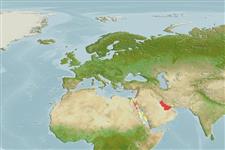
Western Indian Ocean: widespread in the Red Sea, including the Gulf of Suez where it is very common. Lessepsian migrant in the Mediterranean Sea.
Größe / Gewicht / Alter
Geschlechtsreife: Lm ? range ? - ? cm
Max length : 28.2 cm SL Männchen/unbestimmt; (Ref. 101631)
Kurzbeschreibung
Bestimmungsschlüssel | Morphologie | Morphometrie
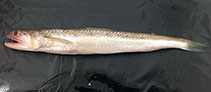
Rückenflossenweichstrahlen (insgesamt) : 11 - 12; Afterflossenweichstrahlen: 10 - 12; Wirbelzahl: 44 - 47. This species is distinguished by the following set of characters: 11-12 dorsal fin-rays; 13-15 pectoral fin-rays; 47-51 lateral-line scales; 4½ transverse scale rows above lateral line, 5½ below lateral line; moderately long pectoral fins (tip of fin extending to between just before or just beyond a line from origin of pelvic fins to origin of dorsal fin); outer palatines with 2 rows of teeth; vomer with 0-2 teeth; tongue with 3-6 rows of teeth posteriorly; slightly compressed caudal peduncle (depth a little more than width); upper margin of caudal fin has a row of 3-8 (usually 6 or 7) distinct blackish spots; color of stomach pale grey to blackish anteriorly; intestine whitish (Ref. 101631).
Body shape (shape guide): elongated; Cross section: circular.
The species is found mainly on sandy or muddy substrates to about 100 m, but observed to be more common inshore close to islands or coasts in depths of 20-30 m. Mainly piscivorous. Spawning season prolonged and occurs nearly all the year round, in the Gulf of Suez with two peaks in December and May (El-Halfawy et al. 2007). In the Mediterranean, spawning season off the coast of Israel lasts from March to December (Golani 1993), whereas at Iskenderun Bay, Turkey, spawning occurs mainly in two seasons (May-July and September-November) (İşmen 2003). Reported to be important in the trawl fishery of the Gulf of Suez and the Mediterranean coast of Egypt, where it is in a state of high overfishing and severe overexploitation. In the Mediterranean, it was rather uncommon until 1955, when it started to appear in large quantities in bottom trawl catches (according to Ben-Yami & Glaser 1974, Ref. 1289; Bilecenoğlu 2010, Ref. 94612); catches have since remained high, with some fluctuations (Golani 1993, Ref. 38081). Also reported to be an economically important fish in the Mersin and Iskenderun Gulfs, Turkey and is among the most common species caught in the trawl fishery, comprising almost one-third of the commercial trawl catch in the north-eastern Levant (Ref. 101631).
Lebenszyklus und Paarungsverhalten
Geschlechtsreife | Fortpflanzung | Ablaichen | Eier | Fruchtbarkeit | Larven
Russell, B.C., D. Golani and Y. Tikochinski, 2015. Saurida lessepsianus a new species of lizardfish (Pisces: Synodontidae) from the Red Sea and Mediterranean Sea, with a key to Saurida species in the Red Sea. Zootaxa 3956(4):559-568. (Ref. 101631)
IUCN Rote Liste Status (Ref. 130435: Version 2025-2 (Global))
Bedrohung für Menschen
Harmless
Nutzung durch Menschen
Fischereien: bycatch
Tools
Zusatzinformationen
Download XML
Internet Quellen
Schätzungen auf der Grundlage von Modellen
Phylogenetischer Diversitätsindex (Ref.
82804): PD
50 = 0.5000 [Uniqueness, from 0.5 = low to 2.0 = high].
Bayesian length-weight: a=0.00513 (0.00245 - 0.01075), b=3.10 (2.93 - 3.27), in cm total length, based on LWR estimates for this Genus-body shape (Ref.
93245).
Trophische Ebene (Ref.
69278): 4.0 ±0.67 se; based on food items.
Widerstandsfähigkeit (Ref.
120179): hoch, Verdopplung der Population dauert weniger als 15 Monate. (Preliminary K or Fecundity.).
Anfälligkeit der Fischerei (Ref.
59153): Low vulnerability (24 of 100).
🛈