>
Callionymiformes (Dragonets) >
Callionymidae (Dragonets)
Etymology: Callionymus: Greek, kallion, comparative of kallos = beautiful + Greek, onyma = name; with a better name; omanensis: Named for its type locality, Oman.
Ambiente: milieu / zona climática / intervalo de profundidade / gama de distribuição
Ecologia
marinhas demersal; intervalo de profundidade ? - 500 m (Ref. 96973). Deep-water
NW Indian Ocean, Arabian Sea, Oman.
Tamanho / Peso / Idade
Maturidade: Lm ? range ? - ? cm
Max length : 11.1 cm SL macho/indeterminado; (Ref. 96973)
Descrição breve
Chaves de identificação | Morfologia | Morfometria
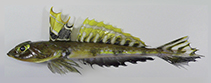
Espinhos dorsais (total) : 4; Raios dorsais moles (total) : 8; Raios anais moles: 8. This species within the subgenus Bathycallionymus is distinguished from its congeners under this by the following characters: small branchial opening; short head short (3.9 in LS); large eye (2.4 in head length); preopercular spine with a long, upcurved main tip, a small antrorse barb and a larger antrorse spine, and a strong antrorse spine at its base, smooth ventral margin; first dorsal fin is slightly higher than the second (in male); second dorsal fin distally straight; pectoral fin rays 17; caudal fin slightly pointed distally, with 2 median unbranched rays with short filaments; first dorsal fin with basal black spot reaching from first to fourth membranes, the third membrane with an ocellated distal black blotch; second dorsal fin with dark grey vertical bars; distal three-fourths of anal fin is black; upper half of caudal fin with dark grey oblique bars; pelvic fin dark grey, second ray basally with a black blotch. This species differs from the similar C. profundus (characters in parentheses) in a more slender preopercular spine with the distance of the two dorsal points more than the length of the longest point (vs. stouter, distance less than the longest point); pectoral fin rays 17 (vs. 18-20); the dark pelvic fin with a black blotch basally on second ray (vs. pale, with a few dark spots); first dorsal fin with a basal black blotch reaching from first to fourth membranes, and a distal ocellate black blotch on third membrane (vs. basal black blotch only reaching from second to third membranes, and third membrane distally dark but not ocellate); distal three-fourths of anal fin dark grey (vs. only distal one-fourth of the anal fin dark); thorax of male plain white (vs. dark grey); snout dorsally with an oblique dark band (vs. without a band, but with a few dark spots); dorsal part of the pectoral fin base pale but with a dark streak behind the pectoral fin (vs. dorsal part black, no dark streak behind pectoral fin); dorsal half of the caudal fin with 4 oblique dark streaks (vs. pale, with a few dark spots). This species differs from Callionymus bentuviai in having just a single dorsal point on the preopercular spine (vs. additional to the small antrorse barb and the main tip; 2 points in C. bentuviai); pectoral fin rays 17 (vs. 19-22); median filaments of the caudal fin short (vs. very long); anal fin with the distal three-fourths dark grey (vs. distal one-fourth dark); dorsal half of the caudal fin with 4 oblique dark streaks (vs. 1 horizontal dark streak); second membrane of the first dorsal fin of the male not deeply incised (vs. deeply incised). This species is distinguished from Callionymus africanus in having just a single dorsal point on the preopercular spine (vs. additional to the small antrorse barb and the main tip; 2 points); first dorsal fin with the basal dark blotch reaching from first to fourth membranes, and a distal black ocellus on third membrane (vs. basal black blotch reaching from second to third membranes, no distal ocellus on third membrane); colouration of the second dorsal fin, with vertical dark grey bars (vs. 2 horizontal rows of dark spots and 3 rows of white spots); anal fin with the distal three-fourths dark grey (vs. distal one-fourth dark); dorsal half of the caudal fin with 4 oblique dark streaks (vs. pale, with a scattered dark spots); depressed body (Ref. 96973).
Body shape (shape guide): elongated; Cross section: other (see remarks).
Ciclo de vida e comportamento de acasalamento
Maturidade | Reprodução | Desova | Ovos | Fecundidade | Larvas
Fricke, R., L.A. Jawad and J.M. Al-Mamry, 2014. Callionymus omanensis, a new species of dragonet from Oman, north-western Indian Ocean (Teleostei: Callionymidae). J. Fish Biol. 85(5):1303-1319. (Ref. 96973)
Categoria na Lista Vermelha da IUCN (Ref. 130435: Version 2025-2 (Global))
Ameaça para o homem
Harmless
Utilização humana
Ferramentas
Relatórios especiais
Descarregue XML
Fontes da internet
Estimativas baseadas em modelos
Índice de diversidade filogenética (Ref.
82804): PD
50 = 0.5000 [Uniqueness, from 0.5 = low to 2.0 = high].
Bayesian length-weight: a=0.00871 (0.00397 - 0.01910), b=2.78 (2.61 - 2.95), in cm total length, based on LWR estimates for this Genus-body shape (Ref.
93245).
Nível Trófico (Ref.
69278): 3.3 ±0.4 se; based on size and trophs of closest relatives
Resiliência (Ref.
120179): Elevada, tempo mínimo de duplicação da população menor que 15 meses (Preliminary K or Fecundity.).
Vulnerabilidade da pesca (Ref.
59153): Low vulnerability (10 of 100).
🛈