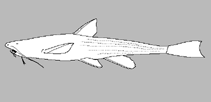
Classification / Noms
Noms communs | Synonymes | Catalog of Fishes(Genre, Espèce) | ITIS | CoL | WoRMS | Cloffa
>
Siluriformes (Catfishes) >
Aspredinidae (Banjo catfishes) > Aspredininae
Etymology: Bunocephalus: Greek, byneo = to fill up, to swell + Greek, kephale = head (Ref. 45335); minerim: The specific name, minerim, refers to the typically regional manner of pronouncing the Portuguese
word 'mineirinho', diminutive of 'mineiro', which pertains to a person that comes from the State of Minas Gerais. The name is in reference to the region where it is found and also to its relative small size in comparison with other species of Bunocephalus. A noun in apposition.
Environnement : milieu / zone climatique / profondeur / gamme de distribution
Écologie
; eau douce démersal. Tropical
South America: upper and middle rio São Francisco basins including the das Velhas, Formoso, Paraopeba and Paracatu rivers in Minas Gerais State, Brazil.
Taille / Poids / Âge
Maturité: Lm ? range ? - ? cm
Max length : 4.9 cm SL mâle / non sexé; (Ref. 104710)
Description synthétique
Clés d'identification | Morphologie | Morphométrie
Rayons mous dorsaux (Total) : 4 - 5; Rayons mous anaux: 7 - 9; Vertèbres: 34 - 37. Bunocephalus minerim is distinguished from all other species of Bunocephalus, except B. larai, by the absence of an epiphyseal bar between the paired frontals (vs. presence of the epiphyseal bar at least in adults). It differs from B. larai and other congeners, except B. chamaizelus, by having 9 principal caudal-fin rays (vs. 10) (Ref. 104710).
Body shape (shape guide): elongated.
Facultative air-breathing in the genus
Cycle de vie et comportement reproducteur
Maturité | Reproduction | Frai | Œufs | Fécondité | Larves
Carvalho, T.P., A.R. Cardoso, J.P. Friel and R.E. Reis, 2015. Two new species of the banjo catfish Bunocephalus Kner (Siluriformes: Aspredinidae) from the upper and middle rio São Francisco basins, Brazil. Neotrop. Ichthyol. 13(3):499-512. (Ref. 104710)
Statut dans la liste rouge de l'IUCN (Ref. 130435: Version 2025-2 (Global))
Menace pour l'homme
Harmless
Utilisations par l'homme
Outils
Articles particuliers
Télécharger en XML
Sources Internet
Estimations basées sur des modèles
Indice de diversité phylogénétique (Réf.
82804): PD
50 = 0.5001 [Uniqueness, from 0.5 = low to 2.0 = high].
Bayesian length-weight: a=0.00324 (0.00137 - 0.00763), b=3.02 (2.81 - 3.23), in cm total length, based on LWR estimates for this (Sub)family-body shape (Ref.
93245).
Niveau trophique (Réf.
69278): 3.1 ±0.3 se; based on size and trophs of closest relatives
Vulnérabilité de la pêche (Ref.
59153): Low vulnerability (10 of 100).
🛈