رده بندی / نامها
اسامي عام | مترادف | Catalog of Fishes(جنس, گونه ها) | ITIS | CoL | WoRMS | Cloffa
>
Eupercaria/misc (Various families in series Eupercaria) >
Lethrinidae (Emperors or scavengers) > Monotaxinae
Etymology: Gymnocranius: Greek, gymnos = naked + Greek, kranion = skull (Ref. 45335); satoi: Named for Torao Sato, a Japanese ichthyologist.
Eponymy: Professor Torao Sato (d: 1945) is a Japanese ichthyologist with expertise in the Lethrinidae (the family of fishes to which this species belongs). [...] (Ref. 128868), visit book page.
محیط زیست: محیط زیست / منطقه آب و هوایی / تغييرات عمق / محدوده توزیع
بوم شناسي
دريايي pelagic-neritic; تغييرات عمق 20 - 40 m (Ref. 107926). Tropical
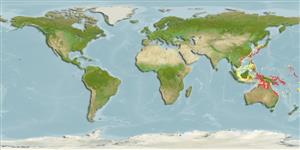
Western Pacific: New Caledonia, West Papua (Raja Ampat), southern Japan and possibly Australia (GBR), the Solomon Sea, Bismarck Sea and New Guinea.
اندازه / وزن / سن
بلوغ: Lm ? range ? - ? cm
Max length : 42.2 cm SL جنس نر / بدون خواص جنسي; (Ref. 107926)
توصيف مختصر
كليدهاي شناسايي | ريخت شناسي | ريخت ستجي بوسيله انداره گيري
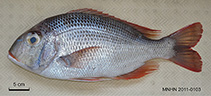
This high-bodied species is distinguished by the following characters: ratio of standard length to body depth between 2.39 and 2.45; bumpy forehead; the lower edge of eye well above axis of body; caudal fin is shallowly forked, the lobes convex on inner side; scale rows above lateral line 6; pored scales on lateral line 47-50; flanks silvery; scales above the lateral line possess a dark-grey basal patch forming longitudinal rows; scales in the three rows below lateral line in middle of flank also forming darker rows, but basal patch not as dark as above lateral line; snout an cheeks with blue speckles against bronze background, distinctive on fresh and larger individuals, but faint on smaller individuals; blue band joining the nostrils on forehead; the area immediately above eye (supraorbital shelf) forming a distinctive brownish to blackish eyebrow; more or less conspicuous vertical dark bar crossing the eye; dorsal, pectoral, anal and caudal fins are reddish to bright vermilion red; upper lip is reddish to red while the lower lip white (Ref. 107926).
Body shape (shape guide): fusiform / normal; Cross section: compressed.
This species apparently lives on the coral sandy bottom in the vicinity of coral reefs (Ref. 107926).
چرخه زندگی و رفتار جفتگیری
بلوغ | تولید مثل | تخم ریزی | تخم ها | باروری | توزاد ( لارو)
Borsa, P., P. Béarez, S. Paijo and W.-J. Chen, 2013. Gymnocranius superciliosus and Gymnocranius satoi, two new large-eye breams (Sparoidea: Lethrinidae) from the Coral Sea and adjacent regions. Comptes Rendus Biologies 336: 233-240. (Ref. 107926)
وضعيت در فهرست قرمز IUCN (Ref. 130435: Version 2025-2 (Global))
خطر برای انسان ها
Harmless
استفاده انسانی
ابزارها
گزارش های ويژه
بارگيری XML
منابع اينترنتي
تخمینها بر اساس مدلها
شاخص تنوع فیلوژنتیکی (مرجع
82804): PD
50 = 0.5005 [Uniqueness, from 0.5 = low to 2.0 = high].
Bayesian length-weight: a=0.01698 (0.00720 - 0.04003), b=2.98 (2.79 - 3.17), in cm total length, based on LWR estimates for this (Sub)family-body shape (Ref.
93245).
سطح تروفیک (مرجع
69278): 3.4 ±0.6 se; based on size and trophs of closest relatives
جهندگی (مرجع
120179): متوسط, كمينه زمان لازم براي دو برابر شدن جمعيت 4/1 – 4/4 سال (Preliminary K or Fecundity.).
آسیبپذیری ماهیگیری (Ref.
59153): Moderate vulnerability (41 of 100).
🛈