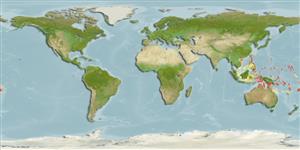
>
Gobiiformes (Gobies) >
Gobiidae (Gobies) > Gobiinae
Etymology: Eviota: No etymology given, suggested by Christopher Scharpt: from Latin 'eu' for 'true' and 'iota' for anything very small, in combination 'truly very small' referring to it as being the smallest vertebrate at the time it has benn described by Jenkins (thus, making the suggestion by Scharpt plausible; teresae: Named for Teresa Arámbula; in genitive case.
Eponymy: Teresa ‘Terry’ Greenfield is the senior author’s wife. She assisted in collecting the type material of the goby, and was thanked for providing field, editorial, and moral support to her husband over many years. (Ref. 128868), visit book page.
Entorno: milieu / zona climática / rango de profundidad / gama de distribución
Ecología
marino asociado a arrecife; rango de profundidad 0 - 26 m (Ref. 107299). Tropical
Indo-Pacific: collected from Fiji (Ref. 107299) and photographed from Indonesia and Maldives (J.Greenfield, pers.comm.).
Tamaño / Peso / Edad
Madurez: Lm ? range ? - ? cm
Max length : 2.1 cm SL macho / no sexado; (Ref. 107299); 1.7 cm SL (female)
Descripción breve
Claves de identificación | Morfología | Morfometría
This species is distinguished by the following characters: complete cephalic sensory-canal pore pattern (pattern 1); dorsal/anal fin formula usually 9/8; pectoral-fin rays usually 18; spot lateral to pelvic-fin base absent; dark occipital spot absent; pectoral-fin base with no distinct dark pigmentation; without a dark spot on mid caudal peduncle; without transverse bars on head and nape; anal fin darker than other fins; in life, orange scale margins; presence of distinct dark spots on ventral side of head; iris reddish with scattered small light spots on dorsal surface; red blotches on sides are deeper than wide; some pectoral-fin rays are branched; fifth pelvic-fin ray about 10-15% of length of fourth ray; no membranes in pelvic fins and the branches are elongate and slender with 2 segments between branches (Ref. 107299).
Body shape (shape guide): elongated; Cross section: oval.
Ciclo vital y comportamiento de apareamiento
Madurez | Reproducción | Puesta | Huevos | Fecundidad | Larva
Greenfield, D.W. and J.E. Randall, 2016. A review of the dwarfgobies of Fiji, including descriptions of five new species (Teleostei: Gobiidae: Eviota). J. Ocean Sci. Found. 20:25-75. (Ref. 107299)
Situación en la Lista Roja de la UICN (Ref. 130435: Version 2025-2 (Global))
Amenaza para el ser humano
Harmless
Usos humanos
Herramientas
Informes especiales
Descargar XML
Fuentes de Internet
Estimaciones basadas en modelos
Índice de diversidad filogenética (Referencia
82804): PD
50 = 0.5000 [Uniqueness, from 0.5 = low to 2.0 = high].
Bayesian length-weight: a=0.00692 (0.00281 - 0.01706), b=3.09 (2.92 - 3.26), in cm total length, based on LWR estimates for this Genus-body shape (Ref.
93245).
Nivel trófico (Referencia
69278): 3.1 ±0.3 se; based on size and trophs of closest relatives
Resiliencia (Referencia
120179): Alto, población duplicada en un tiempo mínimo inferior a 15 meses (Preliminary K or Fecundity.).
Vulnerabilidad pesquera (Ref.
59153): Low vulnerability (10 of 100).
🛈
Nutrientes (Ref.
124155): Calcium = 486 [197, 1,628] mg/100g; Iron = 1.8 [0.7, 4.2] mg/100g; Protein = 17.5 [15.4, 19.5] %; Omega3 = 0.107 [0.033, 0.334] g/100g; Selenium = 36.6 [9.7, 120.1] μg/100g; VitaminA = 107 [19, 569] μg/100g; Zinc = 4.97 [2.55, 8.61] mg/100g (wet weight);