>
Gobiiformes (Gobies) >
Gobiidae (Gobies) > Gobiinae
Etymology: Glossogobius: Greek, glossa = tongue + Latin, gobius = gudgeon (Ref. 45335); mahalonensis: Named for the type locality Lake Mahalona, Sulawesi.
Entorno: milieu / zona climática / rango de profundidad / gama de distribución
Ecología
; agua dulce bentopelágico; rango de profundidad ? - 2 m (Ref. 99936). Tropical
Asia: endemic to Lake Mahalona in Indonesia.
Tamaño / Peso / Edad
Madurez: Lm ? range ? - ? cm
Max length : 5.7 cm SL macho / no sexado; (Ref. 99936)
Descripción breve
Claves de identificación | Morfología | Morfometría
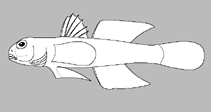
Espinas dorsales (total) : 7; Radios blandos dorsales (total) : 8 - 9; Espinas anales: 1; Radios blandos anales: 7 - 8; Vértebra: 27. Glossogobius mahalonensis is distinsguished by the the following characters: absence of all head pores; mental fraenum indistinct and covered by sensory papillae; cheek naked; operculum with few embedded small scales dorsally; predorsal scaled to near eye; pectoral base scaled; prepelvic area partly scaled, naked anteriorly; second dorsal fin-rays usually I,9; anal-fin rays usually I,8; pectoral rays 14–16; predorsal scales 17–24; pelvic fin oval, length about twice width, rays not thickened; gill opening broad, reaching to a point below end of pupil to posterior end of eye; midsides with horizontally elongate small brown spots (smaller than pupil length) forming a broken horizontal line, often indistinct, not visible in dark specimens; first dorsal fin blue in life; cheek papilla lines with multiple rows of papillae, forming distinct lines (Ref. 99936).
Body shape (shape guide): elongated.
Occurs in the shoreline of the Lake Mahalona. Found in a moderately steep inshore habitat
characterised by mangroves over gravel substrate in the shallows, turning to predominantly rocks alternating with sand and mud in about two meters depth. The habitat was also composed of submerged dead wood, especially in less than two meters depth. Occupies shallows up to about 2 meters depth, but not present in depths between 2 and 12 m, the maximum depth visited by diving at sampling site. Occurs sympatrically with other fish species which include Telmatherina celebensis, Paratherina striata, P. wolterecki, Oryzias marmoratus, Mugilogobius latifrons, M. rexi, Glossogobius intermedius and G. matanensis (Ref. 99936).
Ciclo vital y comportamiento de apareamiento
Madurez | Reproducción | Puesta | Huevos | Fecundidad | Larva
Hoese, D.F., R.K. Hadiaty and F. Herder, 2015. Review of the dwarf Glossogobius lacking head pores from the Malili lakes, Sulawesi, with a discussion of the definition of the genus. Raffles Bulletin of Zoology 63:14-26. (Ref. 99936)
Situación en la Lista Roja de la UICN (Ref. 130435: Version 2025-2 (Global))
Amenaza para el ser humano
Harmless
Usos humanos
Herramientas
Informes especiales
Descargar XML
Fuentes de Internet
Estimaciones basadas en modelos
Índice de diversidad filogenética (Referencia
82804): PD
50 = 0.5000 [Uniqueness, from 0.5 = low to 2.0 = high].
Bayesian length-weight: a=0.00741 (0.00347 - 0.01582), b=3.09 (2.91 - 3.27), in cm total length, based on LWR estimates for this (Sub)family-body shape (Ref.
93245).
Nivel trófico (Referencia
69278): 3.3 ±0.4 se; based on size and trophs of closest relatives
Resiliencia (Referencia
120179): Alto, población duplicada en un tiempo mínimo inferior a 15 meses (Preliminary K or Fecundity.).
Vulnerabilidad pesquera (Ref.
59153): Low vulnerability (10 of 100).
🛈