Élasmobranches (requins et raies) (sharks and rays) >
Rajiformes (Skates and rays) >
Anacanthobatidae (Smooth skates)
Etymology: brevicauda: Name for Latin words 'brevis' for short and 'cauda' for tail; referring to the very short tail.
Environnement : milieu / zone climatique / profondeur / gamme de distribution
Écologie
marin benthopélagique; profondeur 900 - 1130 m (Ref. 109333). Deep-water
Distribution
Territoires | Zones FAO | Écosystèmes | Occurrences | Carte par point | Introductions | Faunafri
Western Indian Ocean: Saya de Malha Bank. High Seas only.
Taille / Poids / Âge
Maturité: Lm ? range ? - ? cm
Max length : 42.2 cm WD (female)
Description synthétique
Clés d'identification | Morphologie | Morphométrie
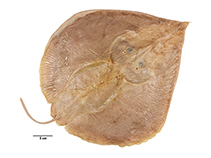
This large western Indian Ocean anacanthobatid species is distinguished by the following characters: grows to about 59.1 cm TL, with an extremely depressed pear-shaped, broad and long disc, its width 71-73% TL and length 76% TL, 0.9-1.0 times as wide as long and with rounded outer corners; head with dorsal length 34% TL, ventral length 41% TL and snout with preorbital length 28-29% TL, preoral length 30% TL, prenasal length 28% TL) long; its snout angle is 90-93°; the snout is terminally expanded as a rostral lobe, 12-13% of preorbital snout length and with a short, thin rostral filament; interorbital distance is rather wide, 4% TL; inner margin of posterior pelvic lobe is fused to root of tail along most of its length, with a short, pointed free tip; very short tail, its length from mid-vent to tail tip 35-36% TL and about half of body length from tip of rostral lobe to mid-vent; tail tapers from anterior part towards about mid-length of tail, becoming slightly broader and flattened in posterior third through lateral keels, and tapering again towards tip from about 2 cm before tip; rudimentary caudal fin with very short and low epichordal and without hypochordal lobe; the upper and lower surfaces of disc and tail are entirely naked and without papillae; colour of upper surface pale grayish-brown, ventral side anteriorly whitish to level of lower jaw and interbranchially, posterior part of disc and underside of tail pale grayish-brown with irregular pale brown blotches at transition from white to brown, the underside of posterior pelvic lobe medium grayish-brown, anterior lobes are dark brown with an indistinct white blotch near the tip and a distinct white blotch at anterior origin; upper jaw tooth rows 25-27; monospondylous vertebral centra 29, diplospondylous centra 102-112, total centra 131-141; the scapulocoracoid is subrectangular, the rear corner sharply marked; moderately large oval anterior fenestra without anterior bridge, one very large oval postdorsal and at least three small postventral fenestrae; pelvic girdle with massive ischiopubic bar with almost straight anterior and broad, shallow trapezoid posterior shape; prepelvic processes are very long and slightly inclined outwards, their length from axis of pelvic girdle maximum width 77.5-90.9% of pelvic girdle maximum width and 4.9-5.6 times median thickness of ischiopubic bar; differs from all other described anacanthobatids in the short tail, which also differentiates it from its morphologically closest congener, the allopatric Sinobatis bulbicauda; further distinguished from other anacanthobatid legskates in the western Indian Ocean (Anacanthobatis marmorata, Indobatis ori) by its large size and light coloration (Ref. 109333).
Body shape (shape guide): other (see remarks); Cross section: flattened.
Cycle de vie et comportement reproducteur
Maturité | Reproduction | Frai | Œufs | Fécondité | Larves
Weigmann, S. and M.F.W. Stehmann, 2016. Sinobatis brevicauda n. sp., a new deep-water legskate (Rajiformes, Anacanthobatidae) and first generic record from the western Indian Ocean. Zootaxa 4137(4):478-500. (Ref. 109333)
Statut dans la liste rouge de l'IUCN (Ref. 130435: Version 2025-2 (Global))
Menace pour l'homme
Harmless
Utilisations par l'homme
Outils
Articles particuliers
Télécharger en XML
Sources Internet
Estimations basées sur des modèles
Indice de diversité phylogénétique (Réf.
82804): PD
50 = 0.5020 [Uniqueness, from 0.5 = low to 2.0 = high].
Bayesian length-weight: a=0.01000 (0.00244 - 0.04107), b=3.04 (2.81 - 3.27), in cm total length, based on all LWR estimates for this body shape (Ref.
93245).
Niveau trophique (Réf.
69278): 3.7 ±0.6 se; based on size and trophs of closest relatives
Vulnérabilité de la pêche (Ref.
59153): Moderate vulnerability (40 of 100).
🛈