Élasmobranches (requins et raies) (sharks and rays) >
Squaliformes (Sleeper and dogfish sharks) >
Squalidae (Dogfish sharks)
Etymology: Squalus: Genus name from Latin 'squalus' meaning shark (Ref. 6885, 27436); albicaudus: Name from Latin 'albus' for white and 'cauda' for tail, referring to the white ventral lobe of its caudal fin.
Environnement : milieu / zone climatique / profondeur / gamme de distribution
Écologie
marin benthopélagique; profondeur 195 - 421 m (Ref. 109601). Tropical
Distribution
Territoires | Zones FAO | Écosystèmes | Occurrences | Carte par point | Introductions | Faunafri
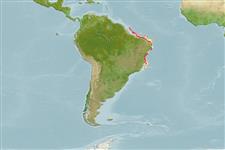
Southwest Atlantic: Brazil (between NE and SE Brazilian coast; often reported between the states of Bahia and Espírito Santo; distribution to southern Brazil is unknown).
Taille / Poids / Âge
Maturité: Lm ? range ? - ? cm
Max length : 52.5 cm TL mâle / non sexé; (Ref. 109601); 59.0 cm TL (female)
Description synthétique
Clés d'identification | Morphologie | Morphométrie
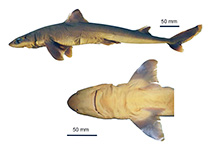
Vertèbres: 110 - 116. This species can be distinguished from its congeners by the following set of characters: caudal fin with a mostly white ventral caudal lobe, its dorsal margin white at midline, and postventral margins broadly white; posterior margin of pectoral-fin broadly white; first dorsal fin with anterior margin also conspicuously white on its anterior half; differs from all species of the S. mitsukurii group with its short snout (vs. large), pectoral-fin free rear tips pointed (vs. rounded), dermal denticles lanceolate and unicuspid (vs. rhomboid and tricuspid); differs from S. cubensis by having a snout strongly pointed (vs. somewhat rounded), second dorsal-fin spine not reaching second dorsal-fin apex (vs. spine reaching second dorsal-fin apex), first dorsal fin with dark apex, but not as a black blotch (vs. distinct black blotch on both dorsal fins), pectoral fins with posterior margin broadly white (vs. narrowly white), in external morphometrics (Squalus albicaudus has a shorter first dorsal fin, anterior margin length 10.9%, 9.7%-11.2% TL vs. 11.6%, 11.6%-12.7% TL, shorter second dorsal fin, anterior margin length 9.2%, 8.8%-10.8% TL vs. 12.3%, 11.2%-11.6% TL, inner margin length 5.0%, 4.1%-5.2% TL vs. 5.6%, 5.5%-6.0% TL, more slender second dorsal-fin spine, width at base 0.9%, 0.6%-0.9% TL vs. 1.0%, 1.0%-1.2%, and clasper much more elongated, inner margin length 7.1%, 6.9%-7.7% TL vs. 8.0%, 3.3%-3.8% TL (Ref. 109601).
Body shape (shape guide): elongated; Cross section: angular.
Cycle de vie et comportement reproducteur
Maturité | Reproduction | Frai | Œufs | Fécondité | Larves
Viana, S.T.d.F., M.R. De Carvalho and U.L. Gomes, 2016. Taxonomy and morphology of species of the genus Squalus Linnaeus, 1758 from the Southwestern Atlantic Ocean (Chondrichthyes: Squaliformes: Squalidae). Zootaxa 4133(1):1-89. (Ref. 109601)
Statut dans la liste rouge de l'IUCN (Ref. 130435: Version 2025-2 (Global))
Menace pour l'homme
Harmless
Utilisations par l'homme
Pêcheries: d'intérêt potentiel
Outils
Articles particuliers
Télécharger en XML
Sources Internet
Estimations basées sur des modèles
Indice de diversité phylogénétique (Réf.
82804): PD
50 = 0.5000 [Uniqueness, from 0.5 = low to 2.0 = high].
Bayesian length-weight: a=0.00347 (0.00163 - 0.00737), b=3.09 (2.92 - 3.26), in cm total length, based on LWR estimates for this Genus-body shape (Ref.
93245).
Niveau trophique (Réf.
69278): 4.2 ±0.3 se; based on size and trophs of closest relatives
Résilience (Réf.
120179): Faible, temps minimum de doublement de population : 4,5 à 14 années (Preliminary K or Fecundity.).
Vulnérabilité de la pêche (Ref.
59153): Moderate vulnerability (44 of 100).
🛈