Klassifizierung / Names
Namen | Synonyme | Catalog of Fishes(Gattung, Arten) | ITIS | CoL | WoRMS | Cloffa
>
Atheriniformes (Silversides) >
Melanotaeniidae (Rainbowfishes, blue eyes)
Etymology: Melanotaenia: Greek, melan, -anos = black + latin, taenia = stripe (Ref. 45335); picta: From the Latin 'picta', meaning painted, in reference to its beautiful color pattern.
Umwelt: Milieu / Klimazone / Tiefenbereich / Verbreitungsgebiet
Ökologie
; süßwasser benthopelagisch. Tropical
Asia: Mareremar River system in Kobroor Island, Aru Islands, Indonesia.
Größe / Gewicht / Alter
Geschlechtsreife: Lm ? range ? - ? cm
Max length : 9.3 cm SL Männchen/unbestimmt; (Ref. 110723); 7.9 cm SL (female)
Kurzbeschreibung
Bestimmungsschlüssel | Morphologie | Morphometrie
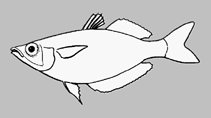
Rückenflossenstacheln (insgesamt) : 5 - 6; Rückenflossenweichstrahlen (insgesamt) : 11 - 14; Afterflossenstacheln: 1; Afterflossenweichstrahlen: 19 - 23. This species can be diagnosed by the following combination of characters: V-VI-I,11-14 dorsal-fin rays; I,19-23 anal-fin rays; 13-16 (usually 14) pectoral-fin rays; 35-36 scales on lateral line, 16-19 predorsal scales; 16-22 (usually > 20) cheek scales; 15-19 total gill rakers on first arch; greatest body depth of adult male 33.9 % SL; color in life generally shades of blue green to blue with metallic reflections and indication of darker blue mid-lateral stripe, most prominent on caudal peduncle where edged below with relatively broad white stripe; in situ color pattern composed of brilliant golden reflections especially conspicuous on each side of midlateral region on side of body and caudal peduncle; and reddish to yellow highlights on dorsal, anal, and caudal fins (Ref. 110723).
Body shape (shape guide): fusiform / normal.
Occupies habitat considered among the most scenic freshwater environments found at the Aru Islands, consisting of small, rainforest brooks with quiet pools interspersed with cascades to 3-4 m high. The habitat has excellent water clarity and stream channels composed of relatively smooth limestone with minimal aquatic vegetation, but abundant shelter for fishes in the form of log snags (Ref. 110723).
Lebenszyklus und Paarungsverhalten
Geschlechtsreife | Fortpflanzung | Ablaichen | Eier | Fruchtbarkeit | Larven
Allen, G.R., R.K. Hadiaty, P.J. Unmack and M.V. Erdmann, 2015. Rainbowfishes (Melanotaenia: Melanotaeniidae) of the Aru Islands, Indonesia with descriptions of five new species and redescription of M. patoti Weber and M. senckenbergianus Weber. aqua, Int. J. Ichthyol. 21(2):66-108. (Ref. 110723)
IUCN Rote Liste Status (Ref. 130435: Version 2025-2 (Global))
Bedrohung für Menschen
Harmless
Nutzung durch Menschen
Fischereien: kommerzielles potential; Aquarium: Potenzial
Tools
Zusatzinformationen
Download XML
Internet Quellen
Schätzungen auf der Grundlage von Modellen
Phylogenetischer Diversitätsindex (Ref.
82804): PD
50 = 0.5000 [Uniqueness, from 0.5 = low to 2.0 = high].
Bayesian length-weight: a=0.01122 (0.00514 - 0.02450), b=3.04 (2.87 - 3.21), in cm total length, based on all LWR estimates for this body shape (Ref.
93245).
Trophische Ebene (Ref.
69278): 2.9 ±0.4 se; based on size and trophs of closest relatives
Widerstandsfähigkeit (Ref.
120179): mittel, Verdopplung der Population dauert 1,4 - 4,4 Jahre. (Preliminary K or Fecundity.).
Anfälligkeit der Fischerei (Ref.
59153): Low vulnerability (10 of 100).
🛈