Classificazione / Nomi
Nomi Comuni | Sinonimi | Catalog of Fishes(Genere, Specie) | ITIS | CoL | WoRMS | Cloffa
>
Atheriniformes (Silversides) >
Melanotaeniidae (Rainbowfishes, blue eyes)
Etymology: Melanotaenia: Greek, melan, -anos = black + latin, taenia = stripe (Ref. 45335); senckenbergiana: Presumably named for the Senckenberg Museum of Frankfurt, Germany, publisher of the journal where the original description of this fish first appeared (Ref. 110723).
Eponymy: Probably named for the Senckenberg Museum, Frankfurt, Germany (the original description was published in the museum journal: Abhandlungen der Senckenbergischen Naturforschenden Gesellschaft) rather than directly after Johann Christian Senckenberg [...] (Ref. 128868), visit book page.
Ambiente: milieu / zona climatica / distribuzione batimetrica / gamma di distribuzione
Ecologia
; acqua dolce benthopelagico. Tropical
Asia: Trangan Island and Kobroor Island in Aru Islands, Indonesia.
Dimensione / Peso / Età
Maturità: Lm ? range ? - ? cm
Max length : 6.4 cm SL maschio/sesso non determinato; (Ref. 110723); 6.8 cm SL (female)
Breve descrizione
Chiavi di identificazione | Morfologia | Morfometria
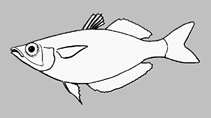
Spine dorsali (totale) : 4 - 6; Raggi dorsali molli (totale) : 11 - 15; Spine anali: 1; Raggi anali molli: 20 - 23. Melanotaenia senckenbergianus is distinguished by the following combination of characters: IV-VI-I,11-15 (usually VVI- I,12-13) dorsal-fin rays; I,20-23 (rarely 23) anal-fin rays; 13-15 (usually 14) pectoral-fin rays; 34-36 scales on lateral line; 16-19 (rarely 19) predorsal scales; 15-24 (average 19.6) cheek scales; 17-18 total gill rakers on first arch; greatest body depth of adult male 35.9 % SL; color in life generally greenish brown dorsally, grading to silvery white to pale yellow ventrally
with midlateral, dark blue stripe, 1-2 scale rows wide, extending from rear margin of eye to caudalfin
base, usually faint or interrupted on middle of side; operculum with prominent red spot, smaller
than pupil (Ref. 110723).
Body shape (shape guide): fusiform / normal.
Inhabits creeks and small rivers flowing through primary rainforest and second growth forest and gardens, as well as tree-lined creeks in relatively open savannah. Syntopic with either Melanotaenia albimarginata, M. aruensis, or M. patoti as well as other fishes such as Craterocephalus, Mogurnda, Glossamia, and Glossogobius (Ref. 110723).
Ciclo vitale e comportamento di accoppiamento
Maturità | Riproduzione | Deposizione | Uova | Fecondità | Larve
Allen, G.R., R.K. Hadiaty, P.J. Unmack and M.V. Erdmann, 2015. Rainbowfishes (Melanotaenia: Melanotaeniidae) of the Aru Islands, Indonesia with descriptions of five new species and redescription of M. patoti Weber and M. senckenbergianus Weber. aqua, Int. J. Ichthyol. 21(2):66-108. (Ref. 110723)
Stato della Lista Rossa IUCN (Ref. 130435: Version 2025-2 (Global))
Minaccia per l'uomo
Harmless
Usi umani
Pesca: di potenziale interesse; Acquario: Potenziale
Strumenti
Rapporti speciali
Scarica XML
Fonti Internet
Stime basate su modelli
Indice di diversità filogenetica (Fonte Biblio.
82804): PD
50 = 0.5000 [Uniqueness, from 0.5 = low to 2.0 = high].
Bayesian length-weight: a=0.01122 (0.00514 - 0.02450), b=3.04 (2.87 - 3.21), in cm total length, based on all LWR estimates for this body shape (Ref.
93245).
Livello trofico (Fonte Biblio.
69278): 2.9 ±0.4 se; based on size and trophs of closest relatives
Resilienza (Fonte Biblio.
120179): Medio, tempo minimo di raddoppiamento della popolazione 1.4 - 4.4 anni (Preliminary K or Fecundity.).
Vulnerabilità della pesca (Ref.
59153): Low vulnerability (10 of 100).
🛈