Klassificering / Namn
Populärnamn | synonymer | Catalog of Fishes(Släkte, Arter) | ITIS | CoL | WoRMS | Cloffa
>
Cichliformes (Cichlids, convict blennies) >
Cichlidae (Cichlids) > Pseudocrenilabrinae
Etymology: Pelvicachromis: Latin, pelvica, -ae = bassin + Greek, chromis = a fish, perhaps a perch (Ref. 45335); drachenfelsi: The species name is dedicated to Ernst-Otto von Drachenfels, Germany, an aquarist, friend and promotor of the research of the authors (Ref. 97630).
Eponymy: Ernst-Otto von Drachenfels is a German biologist, businessman and aquarist since childhood. [...] (Ref. 128868), visit book page.
Miljö: miljö / Klimatzon / djupintervall / distributionsområde
Ekologi
; sötvatten bentopelagisk. Tropical
Africa: Wouri River system in southwestern parts of Cameroon (Ref. 97630).
Storlek / Vikt / Ålder
Könsmognad: Lm ? range ? - ? cm
Max length : 6.0 cm SL hane/ej könsbestämd; (Ref. 97630)
Kort beskrivning
Bestämningsnycklar | Morfologi | Morfometri
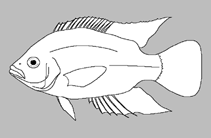
Taggstrålar i ryggfenan (totalt) : 78 - 18; Mjukstrålar i ryggfenan (totalt) : 8 - 9; Taggstrålar i analfenan: 3; Mjukstrålar i analfenan: 7 - 8. Diagnosis: A moderately gracile species, with rounded head and well-developed sexual dimorphism and dichromatism (Ref. 97630). It differs from all congeners with the exception of Pelvicachromis taeniatus by a black margin with a white to pale bluish submargin in the lower half of the male caudal fin, vs. no margin/submargin in the other species, and it differs from all congeners in a white margin and a black submargin in the dorsal half of the male caudal fin, vs. not present (Ref. 97630). It differs in female colouration from P. taeniatus and P. kribensis in showing a dusky blackish margin and absence of horizontal dark bars in the caudal fin (Ref. 97630). It differs from P. taeniatus and P. kribensis in a caudal peduncle usually longer than deep, vs. shorter than deep to as long as deep; it differs from P. humilis, P. rubrolabiatus and P. signatus in the absence of seven-eight dark, vertical bars on body, and in three tubular infraorbital bones vs. two; it differs from P. silviae in a lesser body depth, 28.7-35.1% of standard length vs. 37.4-43.0%, longer caudal peduncle, the caudal peduncle length 93.9-124.6% of caudal peduncle depth vs. 73.2-85.3%, and more spines in dorsal fin, 17-18 vs. 14-16; it differs from P. subocellatus in males by absence of a lappet-like elongation of some rays of caudal fin; it differs from P. roloffi in greater caudal peduncle length, 12.4-18.2% of standard length vs. 9.4-12.2%, and higher number of pored scales of lateral line, 27-29 vs. 24-26; it differs from P. sacrimontis in shorter interorbital distance, 16.3-27.4% of head length vs. 29.4-45.3%; it differs from P. pulcher in rows of dots in the central field of the male caudal fin vs. absence (Ref. 97630).
Body shape (shape guide): fusiform / normal.
This species is restricted to pure freshwater of low conductivity and pH (Ref. 97630).
Livscykel och parningsbeteende
Könsmognad | Reproduktion | Lek | Ägg | Fekunditet | Larver
Lamboj, A., D. Bartel and E. Dell'Ampio, 2014. Revision of the Pelvicachromis taeniatus-group (Perciformes), with revalidation of the taxon Pelvicachromis kribensis (Boulenger, 1911) and description of a new species. Cybium 38(3):205-222. (Ref. 97630)
Status på IUCN:s rödlista (Ref. 130435: Version 2025-2 (Global))
Hot mot människor
Harmless
Mänskliga användningsområden
Verktyg
Särskilda rapporter
Ladda ner XML
Internet-källor
Uppskattningar baserade på modeller
Index för fylogenetisk mångfald (Ref.
82804): PD
50 = 0.5039 [Uniqueness, from 0.5 = low to 2.0 = high].
Bayesian length-weight: a=0.00389 (0.00180 - 0.00842), b=3.12 (2.94 - 3.30), in cm total length, based on all LWR estimates for this body shape (Ref.
93245).
Trofisk nivå (Ref.
69278): 3.2 ±0.4 se; based on size and trophs of closest relatives
Resiliens (Ref.
120179): Hög, lägsta populationsfördubblingstid mindre än 15 månader (Preliminary K or Fecundity.).
Sårbarhet i fisket (Ref.
59153): Low vulnerability (10 of 100).
🛈