การจำแนกประเภท / ชื่อ
ชื่อสามัญ | ชื่อพ้อง | Catalog of Fishes(สกุล, ชนิด) | ITIS | CoL | WoRMS | Cloffa
>
Gobiiformes (Gobies) >
Eleotridae (Bully sleepers)
Etymology: Mogurnda: Aboriginal name used in Australia; kaimana: Named with reference to the nearby town of Kaimana, the capital of Kaimana Regency, within which the type locality is situated.
สิ่งแวดล้อม : สิ่งแวดล้อม / เขตภูมิอากาศ / ระดับความลึก / ระยะการกระจายสินค้า
นิเวศวิทยา
; น้ำจืด สัตว์น้ำหน้าดิน. Tropical
Asia: Lake Furnusu in West Papua, Indonesia.
ขนาด / น้ำหนัก / อายุ
วัยเจริญพันธุ์: Lm ? range ? - ? cm
Max length : 11.0 cm SL เพศผู้/กระเทย; (Ref. 95614)
คำอธิบายสั้นๆ
เครื่องมือที่ใช้ในการแยกชนิดสัตว์,สิ่งมีชีวิตออกจากกัน | สัณฐานวิทยา | ความยาวต่างๆ
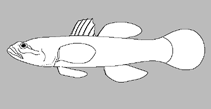
เงี่ยงครีบหลัง (รวม) : 8; ก้านครีบอ่อนที่หาง (รวม) : 11 - 12; ก้านครีบอ่อนที่ก้น: 11 - 12; สัตว์มีกระดูกสันหลัง: 10 - 13. Mogurnda kaimana is distinguished by the following combination of characters: 11 or 12 soft dorsal rays; 12 (rarely 11) soft anal rays; 15-17 (rarely 17) pectoral rays; 36-42 scales in lateral series; 21-25 predorsal scales; usually 9 (80% of specimens with 8-9) rakers on lower limb of first gill arch; body depth at pelvic origin 21.1-26.4% SL; body depth at anal origin 21.1-26.4% SL; head length 34.338.1% SL; interorbital width 11.3-14.2% SL; pelvic-fin length 18.6-25.9% SL; caudal-peduncle depth 12.4-15.2% SL; snout profile concave, especially noticeable in adults, but detectable in juveniles as small as 25 mm SL; and young specimens with a series of about 10 dark squares on sides, gradually developing pattern of numerous irregular spots and blotches on side, becoming increasingly melanistic with age, while adults entirely dark brown, nearly blackish (sometimes with hint of darker mottling) (Ref. 95614).
Body shape (shape guide): elongated.
Found in a small mountain lake, Lake Furnusu. Most of its paratypes occurred adjacent to a rocky shore among aquatic vegetation and submerged Pandanus roots. Other fishes found in the lake are provisionally identified as Neosilurus brevidorsalis (Plotosidae), Craterocephalus sp. (Atherinidae), Melanotaenia mairasi (Melanotaeniidae) , and Oxyeleotris nullipora Eleotridae (Ref. 95614).
วงจรชีวิตและพฤติกรรมการผสมพันธุ์
วัยเจริญพันธุ์ | การสืบพันธุ์ | การวางไข่ | เซลสืบพันธ์ของเพศเมีย(ไข่) | ความดกของไข่ | ตัวอ่อน
Allen, G.R. and R.K. Hadiaty, 2014. Two new species of freshwater gudgeons (Eleotridae: Mogurnda) from the Arguni Bay Region of West Papua, Indonesia. aqua, Int. J. Ichthyol. 20(2):97-110. (Ref. 95614)
สถานะบัญชีแดงของ IUCN (Ref. 130435: Version 2025-2 (Global))
ภัยคุกคามต่อมนุษย์
Harmless
การใช้ของมนุษย์
เครื่องมือ
รายงานพิเศษ
ดาวน์โหลด XML
แหล่งที่มาจากอินเตอร์เน็ต
การประมาณค่าตามแบบจำลอง
ดัชนีความหลากหลายทางวิวัฒนาการ (อ้างอิง
82804): PD
50 = 0.5000 [Uniqueness, from 0.5 = low to 2.0 = high].
Bayesian length-weight: a=0.00741 (0.00323 - 0.01701), b=3.13 (2.94 - 3.32), in cm total length, based on LWR estimates for this (Sub)family-body shape (Ref.
93245).
ระดับชั้นอาหาร (อ้างอิง
69278): 3.4 ±0.5 se; based on size and trophs of closest relatives
ความสามารถในการกลับคืนสู่ปกติ (อ้างอิง
120179): ความสูง, เวลาต่ำสุดที่จะทำให้ประชากรเพิ่มขึ้นเป็น 2 เท่าใช้เวลาน้อยกว่า 15 เดือน (Preliminary K or Fecundity.).
ความเสี่ยงต่อการตกปลา (Ref.
59153): Low vulnerability (10 of 100).
🛈