Classificação / Nomes
Nomes comuns | Sinônimos | Catalog of Fishes(Gênero, Espécies) | ITIS | CoL | WoRMS | Cloffa
>
Siluriformes (Catfishes) >
Amphiliidae (Loach catfishes) > Amphiliinae
Etymology: Amphilius: Greek, amphi = on both sides + Greek, leios = fat; lujani: Named for Nathan K. Lujan who collected the holotype and most paratypes of this species, and who has made excellent contributions to our knowledge of freshwater fishes (Ref. 103388).
Eponymy: Dr Nathan Keller Lujan (d: 1976) is an ichthyologist, taxonomist, ecologist and evolutionary biologist who is a postdoctoral researcher at the Canadian Department of Fisheries and Oceans, Toronto. [...] (Ref. 128868), visit book page.
Meio ambiente: milieu / Zona climática / intervalo de profundidade / faixa de distribuição
Ecologia
; Água doce demersal. Tropical
Africa: Lake Kyoga drainage (Ref. 103388), Lake Victoria drainage (Ref. 52331, 103388) and Lake Manyara basin in Tanzania (Ref. 103388).
Tamanho / Peso / Idade
Maturidade: Lm ? range ? - ? cm
Max length : 12.0 cm SL macho/indeterminado; (Ref. 103388)
Descrição suscinta
Chaves de identificação | Morfologia | Morfometria
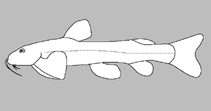
Espinhos dorsais (total) : 0; Raios dorsais (total) : 7 - 8; Espinhos anais: 0; Raios anais : 8 - 10. Diagnosis: Amphilius lujani is diagnosed from A. pedunculus, A. frieli and A. crassus by having a more slender caudal peduncle, its depth 8.1-9.5% of standard length vs. 9.9-12.3% (Ref. 103388). It is diagnosed from A. jacksonii by having a deeper caudal peduncle, its depth 8.1-9.5% of standard length vs. 4.8-7.9%, and a deeper body, body depth at anus 13.5-15.8% of standard length vs. 9.6-13.2%; it is diagnosed from A. ruziziensis by having a wider interorbital width, 28.3-31.7% of head length vs. 23.4-25.1%, and a deeper body, body depth at anus 13.5-15.8% of standard length vs. 11.1-12.9%; it is further diagnosed from A. frieli by having fewer gill rakers on the first gill arch, 6-8, rarely 5 or 9 vs. 10-11, rarely 9 or 12, and a longer caudal peduncle, its length 16.8-20.9% of standard length vs. 14.4-16.4%; it is further diagnosed from A. crassus by having more branched pectoral-fin rays, 9 vs. 7-8, rarely 9, and a longer caudal peduncle, its length 16.8-20.9% of standard length vs. 13.3-15.5% (Ref. 103388).
Body shape (shape guide): elongated.
Ciclo de vida ou comportamento de acasalamento
Maturidade | Reprodução | Desova | Ovos | Fecundidade | Larvas
Thomson, A.W., L.M. Page and S.A. Hilber, 2015. Revision of the Amphilius jacksonii complex (Siluriformes: Amphiliidae), with the descriptions of five new species. Zootaxa 3986(1):61-87. (Ref. 103388)
Status na Lista Vermelha da UICN (Ref. 130435: Version 2025-2 (Global))
Ameaça para os humanos
Harmless
Uso pelos humanos
Ferramentas
Relatórios especiais
Baixar XML
Fontes da internet
Estimativas baseadas em modelos
Índice de diversidade filogenética (Ref.
82804): PD
50 = 0.5000 [Uniqueness, from 0.5 = low to 2.0 = high].
Bayesian length-weight: a=0.00490 (0.00203 - 0.01181), b=3.15 (2.94 - 3.36), in cm total length, based on LWR estimates for this (Sub)family-body shape (Ref.
93245).
Nível Trófico (Ref.
69278): 3.0 ±0.3 se; based on size and trophs of closest relatives
Resiliência (Ref.
120179): médio(a), tempo mínimo de duplicação da população 1,4 - 4,4 anos (Preliminary K or Fecundity.).
Vulnerabilidade da pesca (Ref.
59153): Low vulnerability (10 of 100).
🛈