वर्गीकरण / नाम
आम नाम | उपशब्द | Catalog of Fishes(वर्ग, प्रजाति) | ITIS | CoL | WoRMS | Cloffa
इलाज़मौबरांकी (शारक और रेज़) (sharks and rays) >
Myliobatiformes (Stingrays) >
Dasyatidae (Stingrays) > Urogymninae
Etymology: Urogymnus: Greek, oura = tail + Greek, gymnos = naked (Ref. 45335); acanthobothrium: Named for the cestode parasites (genus Acanthobothrium) found in this species; noun in apposition.
पर्यावरण: पर्यावरण / जलवायु क्षेत्र / गहराई सीमा / वितरण सीमा
पारिस्थितिकी
समुद्री; खारा बेनथोपिलाजिक; गहराई सीमा 2 - 20 m (Ref. 110274). Tropical
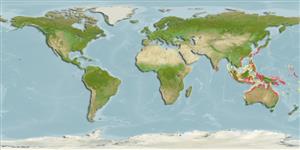
Western Pacific: western Australia and Papua New Guinea.
आकार / वज़न / आयु
परिपक्व अवधि: Lm ? range ? - ? cm
Max length : 103 cm WD पुल्लिंग / अलिंग; (Ref. 110274); 161.0 cm WD (female)
संक्षिप्त वर्णन
पहचान कुंजी | आकृति विज्ञान | मौरफोमैटरिक्स
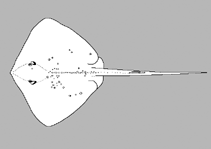
This species is distinguished by the following set of characters: elongate disc suboval with the snout tip to axis of maximum width 53% DW; anterior disc margin not truncated, it is almost straight with lateral apices broadly rounded; preorbital snout broadly angular, its angle 114° and with a very small apical lobe; preorbit long, its length 26% TL, 2.1 times interorbital length; orbits are small and protruded slightly; spiracle is very large, 8.6% DW, 1.9 in orbit diameter; internasal distance is 2.0 in prenasal length, 2.8 times nostril length; preoral snout length is 2.6 times mouth width, 2.5 times internarial distance; caudal sting very large with its length more than a 30% DW; mid-scapular denticles are very small and inconspicuous; secondary denticles are very small, rather widely spaced, band delimited but margin not sharply defined, band truncate forward of eye; presence of minute upright tertiary denticles, barely visible; with a low and short-based ventral tail fold; dorsal disc colour is variable, juveniles plain dark greyish brown to yellowish brown, while in adults very finely and faintly mottled greyish white to yellowish brown; its ventral surface is largely white, posterior disc without regular dark margins; tail beyond sting white in young, while in adults it is unknown but possibly paler than anterior tail; propterygial radials 66, 3 times the number of mesopterygial radials; 151 total vertebral segments (excluding synarcual) (Ref. 110274).
Body shape (shape guide): other (see remarks); Cross section: flattened.
Juveniles were recorded from lower reaches of rivers at depths of 2.2-8.7 m; salinity 14.6-33.1; turbidity 367->1000 NTU. Subadult specimens were from depths of 10-20 m. An adult female (161.0 cm DW, 174.0 cm disc length) aborted a late embryo which was estimated to be ca. 26.5 cm DW on capture. Juveniles (5) measured 39.o - 67.2 cm DW, 43.0-72.0 cm DL, while a late adolescent male measured 103.0 cm DW, This stingray could be traditionally hunted for food and the caudal sting can be used as a traditional knife. (Ref. 110274).
जीवन चक्र और संभोग व्यवहार
परिपक्व अवधि | पुनरुत्पत्ति | मछलीऔ का अंडे देना | अंडे | उपजाऊपन | लार्वा
Last, P.R., W.T. White and P.M. Kyne, 2016. Urogymnus acanthobothrium sp. nov., a new euryhaline whipray (Myliobatiformes: Dasyatidae) from Australia and Papua New Guinea. Zootaxa 4147(2):162-176. (Ref. 110274)
आईयूसीएन रेड लिस्ट स्थिति (Ref. 130435: Version 2025-2 (Global))
मनुष्यों के लिए ख़तरा
Harmless
मानव उपयोग
साधन
विशेष रिपोर्ट
XML डाउनलोड करें
इंटरनेट स्रोत
मॉडल पर आधारित अनुमान
जातिवृति विविधता सूचकांक (संदर्भ
82804): PD
50 = 0.5156 [Uniqueness, from 0.5 = low to 2.0 = high].
Bayesian length-weight: a=0.01023 (0.00482 - 0.02174), b=3.06 (2.86 - 3.26), in cm total length, based on LWR estimates for this (Sub)family-body shape (Ref.
93245).
ट्रॉफिक स्तर (संदर्भ
69278): 3.5 ±0.4 se; based on size and trophs of closest relatives
मछली पकड़ने की भेद्यता (Ref.
59153): Very high vulnerability (90 of 100).
🛈