>
Eupercaria/misc (Various families in series Eupercaria) >
Labridae (Wrasses) > Cirrhilabrinae
Etymology: Cirrhilabrus: Latin, cirrus = curl fringe + Greek, labros = furious (Ref. 45335); hygroxerus: From Greek hygros, meaning wet, and xeros, meaning dry, refering to monsoonal cycle of wet and dry seasons of northern tropical Australia; name also intended as acknowledgment of Monsoon Aquatics, the aquarium fish company that supplied all of the type specimens; species epithet a noun in apposition (Ref. 112597).
Entorno: milieu / zona climática / rango de profundidad / gama de distribución
Ecología
marino asociado a arrecife; rango de profundidad 18 - 37 m (Ref. 112597). Tropical
Eastern Indian Ocean: currently known only from a single reef area in the eastern Timor Sea, approximately 200 km north of Darwin, Australia (Ref. 112597).
Tamaño / Peso / Edad
Madurez: Lm ? range ? - ? cm
Max length : 5.6 cm SL macho / no sexado; (Ref. 112597); 5.1 cm SL (female)
Descripción breve
Claves de identificación | Morfología | Morfometría
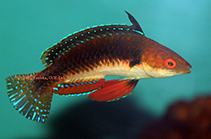
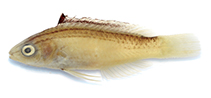
Espinas dorsales (total) : 11; Radios blandos dorsales (total) : 9; Espinas anales: 3; Radios blandos anales: 9; Vértebra: 25. This species is distinguished by the following characters: D XI,9; A III,9; pectoral-fin rays 15; lateral-line scales 15-17 + 4-8; median predorsal scales 4-5; single horizontal scale rows on cheek below eye; gill rakers 11-14 (usually 13); body depth 3.3-4.0 in SL; head length 2.7-3.0 in SL; snout length 3.5-4.5 in HL; dorsal fin more or less uniform height except for elevated pennant comprised of membranous extension between 1st 2 spines, well-developed in mature males, 1.4-2.2 in HL; pelvic fins of male moderately elongate, reaching posteriorly to about base of 1st soft anal-fin ray, 2.6-3.2 in SL; caudal fin rounded; male in life mainly blackish on upper half of body and white below; upper half of head yellow orange; dorsal fin mainly blackish, anal fin scarlet red with row of blue spots at base; pelvic fins scarlet red with black area at base; pectoral fins with prominent black base; female in life yellow orange on upper 2/3 of head, grading to scarlet red on body; lower part of head, breast, and belly white; head and body with 4 narrow, lavender stripes; dorsal fin dusky red, yellowish basally, often with blackish or grey membrane between 1st 2 spines; anal and pelvic fins red-orange to pinkish; pectoral fins translucent with conspicuous yellow base (Ref. 112597).
Body shape (shape guide): fusiform / normal.
Collected and observed in depths of about 18-37 m; the habitat appears to be localized to sloping rubble bottoms with scattered, low outcrops of rock or coral and occasional large coral outcrops (Ref. 112597).
Ciclo vital y comportamiento de apareamiento
Madurez | Reproducción | Puesta | Huevos | Fecundidad | Larva
Allen, G.R. and M.P. Hammer, 2016. Cirrhilabrus hygroxerus, a new species of fairy wrasse (Pisces: Labridae) from the Timor Sea, northern Australia. J. Ocean Sci. Found. 22:41-52. (Ref. 112597)
Situación en la Lista Roja de la UICN (Ref. 130435: Version 2025-2 (Global))
Amenaza para el ser humano
Harmless
Usos humanos
Herramientas
Informes especiales
Descargar XML
Fuentes de Internet
Estimaciones basadas en modelos
Índice de diversidad filogenética (Referencia
82804): PD
50 = 0.5000 [Uniqueness, from 0.5 = low to 2.0 = high].
Bayesian length-weight: a=0.01072 (0.00427 - 0.02691), b=3.03 (2.81 - 3.25), in cm total length, based on LWR estimates for this (Sub)family-body shape (Ref.
93245).
Nivel trófico (Referencia
69278): 3.3 ±0.4 se; based on size and trophs of closest relatives
Resiliencia (Referencia
120179): Alto, población duplicada en un tiempo mínimo inferior a 15 meses (Preliminary K or Fecundity.).
Vulnerabilidad pesquera (Ref.
59153): Low vulnerability (10 of 100).
🛈