Classificatie / Namen
Lokale namen | Synoniemen | Catalog of Fishes(Genus, Soort(en)) | ITIS | CoL | WoRMS | Cloffa
>
Cypriniformes (Carps) >
Psilorhynchidae (Mountain carps)
Etymology: Psilorhynchus: Greek, psilos = hairless + Greek, rhyngchos = snout (Ref. 45335); tysoni: Named for Tyson R. Roberts who collected the majority of the specimens in the type series and made them available for study; a noun in genitive (Ref. 110241).
Eponymy: Dr Tyson Royal Roberts (d: 1940) is an American naturalist and evolutionary biologist who has devoted most of his life to studying biodiversity, particularly that of fishes, throughout the tropics. [...] (Ref. 128868), visit book page.
Milieu: milieu / Klimaatzone / Diepte / verspreidingsgebied
Ecologie
; zoet water benthopelagisch. Tropical
Asia: known currently only from a few localities on the Mae Nam Moei and its tributary the Hue Mae Song, Tak Province, Thailand (Ref. 110241).
Grootte / Gewicht / Leeftijd
Maturiteit: Lm ? range ? - ? cm
Max length : 5.4 cm SL mannelijk / geslacht onbekend; (Ref. 110241)
Korte beschrijving
Determinatiesleutels | Morfologie | Morfometrie
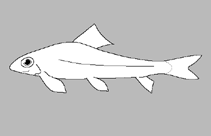
Dorsale zachte stralen (totaal) : 12; Anale zachte stralen: 8; Wervels: 34. Diagnosis: 6–7 dorsal saddles along dorsal midline, including 1-2 between occiput and dorsal-fin origin and 5-6 from dorsal-fin origin to caudal-fin origin; posteriormost dorsal saddle at caudal-fin origin small but prominent and represented by black or dark brown spot; L+1 and L-1 rows restricted to center of body side, not extending posterior to vertical through anal-fin origin; L+2 row absent; dorsal-fin with poorly developed dark brown or black markings along anterior margin; 2 widely separate dark brown or black markings on both upper and lower caudal fin lobes; anguloarticular portion of preoperculo-mandibular canal present; principal caudal-fin rays 10+9; total vertebrae 34 (17+17); body shallow (14–18% SL); caudal peduncle short (11–14% SL); snout short (35–43% HL); mouth narrow (mouth width 21-26% HL) (Ref. 110241).
Body shape (shape guide): elongated.
Collected in swift flowing water of shallow to moderate (50-100 cm) depth over a substrate of sand and gravel; water parameters measured at this locality at time of collection include: 21C, pH 7.5, KH 3, GH 0 (Ref. 110241).
Levenscyclus en paargedrag
Maturiteit | Voortplanting | Paaien | Eieren | Fecunditeit | Larven
Conway, K.W. and A.K. Pinion, 2016. Psilorhynchus tysoni, a new species of torrent minnow from the Salween River drainage, western Thailand (Teleostei: Psilorhynchidae). Zootaxa 4136(3):580-592. (Ref. 110241)
Status op de Rode Lijst van het IUCN (Ref. 130435: Version 2025-2 (Global))
Gevaar voor de mens
Harmless
Gebruik door de mens
Visserij: van geen belang
Tools
Speciale rapporten
Download XML
Internetbronnen
Schattingen op basis van modellen
Fylogenetische diversiteitsindex (Ref.
82804): PD
50 = 0.5000 [Uniqueness, from 0.5 = low to 2.0 = high].
Bayesian length-weight: a=0.00417 (0.00178 - 0.00974), b=3.16 (2.95 - 3.37), in cm total length, based on LWR estimates for this (Sub)family-body shape (Ref.
93245).
Trofisch niveau (Ref.
69278): 3.0 ±0.2 se; based on size and trophs of closest relatives
Kwetsbaarheid van de visserij (Ref.
59153): Low vulnerability (10 of 100).
🛈