Пластиножаберные (акулы и скаты) (sharks and rays) >
Rhinopristiformes (Shovelnose rays) >
Rhinidae (Wedgefishes)
Etymology: Rhynchobatus: Greek, rhingchos = snout + Greek, batis, -idos = a sting ray (Raja sp.) (Ref. 45335); immaculatus: Name from Latin 'im' meaning not and 'macula' for spot, mark; based on the lack of a dark pectoral marking (rather than any white spots) which is otherwise present in small individuals of other nominal species of Rhynchobatus.
Окружающая среда: среда / климатическая зона / пределы глубины / диапазон распространения
экология
морской pelagic-neritic. Subtropical; 23°N - 25°N, 120°E - 122°E (Ref. 114953)
распространение
Территории | регионы FAO | Экосистемы | места находок | карта точек | интродукции | Faunafri
Northwest Pacific: confirmed from Taiwan; probably more widespread.
Размер / Вес / Возраст
половая зрелость: Lm ? range ? - ? cm
Max length : 99.0 cm TL самец/пол неопределен; (Ref. 94805)
Краткое описание
определительные ключи | морфология | морфометрия
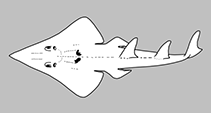
This medium-sized species is distinguished by the following set of characters: snout is broad, and wedge-shaped; preoral snout 19-21% TL; small eye, its length 4.1-4.5 in preorbital snout; interorbital space 2.6-2.9 in preorbital snout; about 48 tooth rows; no spines from snout; supraorbital spines are small, well differentiated, and extending from preorbit to beyond end of spiracle; predorsal spines are relatively well developed; 2 disjunct rows of 6-9 small scapular spines on each side of the disc; predorsal space 48-49% of total length; origin of the first dorsal fin is well behind origin of pelvic-fin bases; total pectoral-fin radials 65-68; vertebrae with 28-30 monospondylous precaudal centra, 124-131 precaudal free centra, 38-42 diplospondylous caudal (free) centra, 165-170 total free centra, 179-184 total centra (including synarcual centra). Colouration: dark greenish brown dorsally with a few white spots scattered on pectoral disc; no black pectoral marking; prominent row of white spots start just forward of a single white spot (above pelvic-fin origin) and coalescing posteriorly to form a white mid-lateral line on tail; orbital membrane is white with dark bar over eye; no alternating light and dark markings on the interorbital space (Ref. 94805).
Body shape (shape guide): other (see remarks); Cross section: flattened.
A benthic species that was recently discovered and not well known, but apparently lives in shallow water on the continental shelf. Probably feeds on bottom-dwelling crustaceans and fishes (Ref. 114953). Specimens caught are all immature that most probably the maximum length of this medium-size wedgefish could be less than 150 cm TL (Ref. 94805).
Жизненный цикл и брачное поведение
половая зрелость | размножение | нерест | икра | Плодовитость | личинки
Last, P.R., H.-H. Ho and R.-R. Chen, 2013. A new species of wedgefish, Rhynchobatus immaculatus (Chondrichthyes: Rhynchobatidae), from Taiwan. Zootaxa 3752(1):185-198. (Ref. 94805)
Статус Красного Списка МСОП (Ref. 130435: Version 2025-2 (Global))
Угроза для людей
Harmless
Использование человеком
дополнительная информация
инструменты
Специальные отчеты
Скачать в формате XML
ресурсы в Интернет
Оценки, основанные на моделях
Индекс филогенетического разнообразия (ссылка
82804): PD
50 = 0.5024 [Uniqueness, from 0.5 = low to 2.0 = high].
Bayesian length-weight: a=0.01000 (0.00244 - 0.04107), b=3.04 (2.81 - 3.27), in cm total length, based on all LWR estimates for this body shape (Ref.
93245).
Трофический уровень (ссылка
69278): 3.5 ±0.6 se; based on size and trophs of closest relatives
Уязвимость рыбной ловли (Ref.
59153): High vulnerability (60 of 100).
🛈