>
Gobiiformes (Gobies) >
Gobiidae (Gobies) > Gobiinae
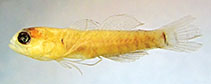
Etymology: Eviota: No etymology given, suggested by Christopher Scharpt: from Latin 'eu' for 'true' and 'iota' for anything very small, in combination 'truly very small' referring to it as being the smallest vertebrate at the time it has benn described by Jenkins (thus, making the suggestion by Scharpt plausible; bilunula: Name from Latin 'bi' meaning two and 'lunula' for little moon; referring to the two distinctive black crescent-shaped marks underneath the pectoral fin; nominative singular feminine adjective.
Environnement : milieu / zone climatique / profondeur / gamme de distribution
Écologie
marin récifal; profondeur ? - 14 m (Ref. 113376). Tropical
Distribution
Territoires | Zones FAO | Écosystèmes | Occurrences | Carte par point | Introductions | Faunafri
Western Central Pacific: Fiji.
Taille / Poids / Âge
Maturité: Lm ? range ? - ? cm
Max length : 1.1 cm SL mâle / non sexé; (Ref. 113376); 1.0 cm SL (female)
Description synthétique
Clés d'identification | Morphologie | Morphométrie
Épines dorsales (Total) : 7; Rayons mous dorsaux (Total) : 7 - 8; Épines anales: 1; Rayons mous anaux: 7. This species is distinguished by the following characters: cephalic sensory-canal pore system missing only IT pore (pattern 2); dorsal/anal fin-ray formula 7/7 or 8/7; unbranched pectoral-fin rays; 5th pelvic-fin ray 15.9-16.4% of 4th ray; presence of a narrow dark bar at caudal-fin base; with a red line extending down from under eye to jaws; there are 5 postanal ventral-midline spots associated with subcutaneous bars; 2 distinctive black crescent-shaped marks present underneath the pectoral fin (Ref. 113376).
Body shape (shape guide): elongated; Cross section: oval.
Collected from rubble bottom by clove oil at 13.5 m depth (Ref. 113376).
Cycle de vie et comportement reproducteur
Maturité | Reproduction | Frai | Œufs | Fécondité | Larves
Greenfield, D.W. and T. Suzuki, 2016. Eviota bilunula, a new dwarfgoby from Fiji, with a redescription of Eviota flebilis (Teleostei: Gobiidae). J. Ocean Sci. Found. 24:1-9. (Ref. 113376)
Statut dans la liste rouge de l'IUCN (Ref. 130435: Version 2025-2 (Global))
Menace pour l'homme
Harmless
Utilisations par l'homme
Outils
Articles particuliers
Télécharger en XML
Sources Internet
Estimations basées sur des modèles
Indice de diversité phylogénétique (Réf.
82804): PD
50 = 0.5000 [Uniqueness, from 0.5 = low to 2.0 = high].
Bayesian length-weight: a=0.00692 (0.00281 - 0.01706), b=3.09 (2.92 - 3.26), in cm total length, based on LWR estimates for this Genus-body shape (Ref.
93245).
Niveau trophique (Réf.
69278): 2.9 ±0.3 se; based on size and trophs of closest relatives
Résilience (Réf.
120179): Haut, temps minimum de doublement de population inférieur à 15 mois (Preliminary K or Fecundity.).
Vulnérabilité de la pêche (Ref.
59153): Low vulnerability (10 of 100).
🛈