>
Gobiiformes (Gobies) >
Gobiidae (Gobies) > Gobiinae
Etymology: Trimma: Greek, trimma, -atos = something crushed (Ref. 45335); hollemani: Named for Wouter Holleman, a world expert on the systematics of tripterygiid and clinid fishes.
Eponymy: Wouter Holleman is a Research Associate at the South African Institute for Aquatic Biodiversity. [...] (Ref. 128868), visit book page.
Miljö: miljö / Klimatzon / djupintervall / distributionsområde
Ekologi
marina pelagic-neritic; djupintervall 8 - 70 m (Ref. 109919). Tropical
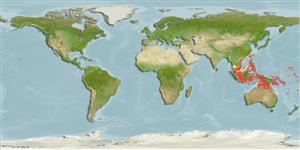
Western Pacific: the Philippines, Malaysia, Indonesia, Australia and Papua New Guinea.
Storlek / Vikt / Ålder
Könsmognad: Lm ? range ? - ? cm
Max length : 2.8 cm SL hane/ej könsbestämd; (Ref. 109919)
Kort beskrivning
Bestämningsnycklar | Morfologi | Morfometri
Taggstrålar i ryggfenan (totalt) : 7; Mjukstrålar i ryggfenan (totalt) : 7 - 8; Taggstrålar i analfenan: 1; Mjukstrålar i analfenan: 7 - 8. This species is distinguished by the following characters: a bony interorbital 82-100% pupil diameter; usually 11 ctenoid scales in predorsal midline; second dorsal spine may reach to the base of the third dorsal fin ray (in mature males) or anterior to this point; usually five free neuromasts (sensory papillae) in row r on the top of the snout, pectoral-fin rays usually 14-15 with 1-4 branched rays in about half the individuals; an unbranched fifth pelvic-fin ray that is 47-64% the length of the fourth ray. Colour of freshly collected specimens: a red to yellow background colour, a light stripe along the mid-lateral body that continues forward over the top of the pupil ending posteriorly at a pale bar across the peduncle in front of the dark caudal blotch; a light stripe below the eye bordered dorsally by a narrow red stripe (both light stripes blue in life). In preserved specimens, the central dark stripe on the snout (blue in life) is usually made up of amorphous brown chromatophores, often with a few scattered rounded very dark chromatophores, a dark blotch made up of rounded brown chromatophores on chin just behind the symphysis, and at least some dark chromatophores on the lower lip (Ref. 109919).
Body shape (shape guide): elongated; Cross section: oval.
Found in caves of reef slopes also with overhangs and crevices; in areas with sand, some rubble and gorgonians, small, hard and soft corals, Tubastrea, sea whips, some black coral, sea fans, tunicates, sponges, some hydroids (Ref. 109919).
Livscykel och parningsbeteende
Könsmognad | Reproduktion | Lek | Ägg | Fekunditet | Larver
Winterbottom, R., 2016. Trimma tevegae and T. caudomaculatum revisited and redescribed (Acanthopterygii, Gobiidae), with descriptions of three new similar species from the western Pacific. Zootaxa 4144(1):001-053. (Ref. 109919)
Status på IUCN:s rödlista (Ref. 130435: Version 2025-2 (Global))
Hot mot människor
Harmless
Mänskliga användningsområden
Fiskeri: saknar intresse
Verktyg
Särskilda rapporter
Ladda ner XML
Internet-källor
Uppskattningar baserade på modeller
Index för fylogenetisk mångfald (Ref.
82804): PD
50 = 0.5000 [Uniqueness, from 0.5 = low to 2.0 = high].
Bayesian length-weight: a=0.00741 (0.00347 - 0.01582), b=3.09 (2.91 - 3.27), in cm total length, based on LWR estimates for this (Sub)family-body shape (Ref.
93245).
Resiliens (Ref.
120179): Hög, lägsta populationsfördubblingstid mindre än 15 månader (Preliminary K or Fecundity.).
Sårbarhet i fisket (Ref.
59153): Low vulnerability (10 of 100).
🛈