Classificazione / Nomi
Nomi Comuni | Sinonimi | Catalog of Fishes(Genere, Specie) | ITIS | CoL | WoRMS | Cloffa
>
Cyprinodontiformes (Rivulines, killifishes and live bearers) >
Profundulidae (Middle American killifishes)
Etymology: Profundulus: Latin, profundus = deep (Ref. 45335); mixtlanensis: Derived from the word 'Mixtlan' in the Nahuatl language. The Tenoch culture used to call Mixtlan the region where the new species occurs. Mixtlan is a compound word, consisting of words Mixtli (cloud) and -Tlan (place). It means 'the place of the clouds'.
Ambiente: milieu / zona climatica / distribuzione batimetrica / gamma di distribuzione
Ecologia
; acqua dolce benthopelagico. Tropical
Central America: Oaxaca, Mexico in the following river systems: Colorado River, Atoyaquillo River, the Atoyac river basin, and the Mixteco river basin.
Dimensione / Peso / Età
Maturità: Lm ? range ? - ? cm
Max length : 6.7 cm SL maschio/sesso non determinato; (Ref. 106146)
Breve descrizione
Chiavi di identificazione | Morfologia | Morfometria
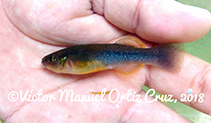
Raggi dorsali molli (totale) : 10 - 13; Raggi anali molli: 12 - 21. Profundulus mixtlanensis can be diagnosed from other congeners by the following characters: a pronounced lower jaw; 30-35 lateral scales; lack dark body spotting on the posterior half of the body caused by melanization of the base of the scales; in lateral view, dorsal profile of the head shows a concavity just above the supra-occipital crest, which quickly reaches a flat profile posteriorly, an attribute that becomes more pronounced with age; body height <2/3 of SL; pre-pectoral distance <1/3 of SL; distance between ventral and anal fins 15% of SL; caudal peduncle depth 13% of SL; post-anal length 15% of SL; head length 26-28% of SL; preorbital length 26-30% of HL; eye diameter 26-28% of SL; anal-fin length 16-17% of SL; 30-35 lateral scales; 12-21 anal-fin rays; 14-17 pectoral-fin rays (Ref. 106146).
Body shape (shape guide): fusiform / normal.
Occurs in springs at altitudes between 710 and 2,300, but mostly above 2000 m (Ref. 106146).
Ciclo vitale e comportamento di accoppiamento
Maturità | Riproduzione | Deposizione | Uova | Fecondità | Larve
Ornelas-García, C.P., E. Martínez-Ramírez and I. Doadrio, 2015. A new species of killifish of the family Profundulidae from the highlands of the Mixteca region, Mexico. Revista Mexicana de Biodiversidad 86(4):926-933. (Ref. 106146)
Stato della Lista Rossa IUCN (Ref. 130435: Version 2025-2 (Global))
Minaccia per l'uomo
Harmless
Usi umani
Strumenti
Rapporti speciali
Scarica XML
Fonti Internet
Stime basate su modelli
Indice di diversità filogenetica (Fonte Biblio.
82804): PD
50 = 0.5021 [Uniqueness, from 0.5 = low to 2.0 = high].
Bayesian length-weight: a=0.01380 (0.00555 - 0.03435), b=3.04 (2.83 - 3.25), in cm total length, based on LWR estimates for this (Sub)family-body shape (Ref.
93245).
Livello trofico (Fonte Biblio.
69278): 3.2 ±0.4 se; based on size and trophs of closest relatives
Vulnerabilità della pesca (Ref.
59153): Low vulnerability (10 of 100).
🛈