Classificatie / Namen
Lokale namen | Synoniemen | Catalog of Fishes(Genus, Soort(en)) | ITIS | CoL | WoRMS | Cloffa
>
Cypriniformes (Carps) >
Cyprinidae (Minnows or carps) > Smiliogastrinae
Etymology: Enteromius: Greek, enteron = intestine + Greek, myo, mys = muscle (Ref. 45335); potamogalis: The species or trivial name potamogalis evidently refers to a highly distinctive fish-eating mammal, the West African water shrew potamogale velox Du Chaillu, 1868 (Ref. 85567).
Milieu: milieu / Klimaatzone / Diepte / verspreidingsgebied
Ecologie
; zoet water benthopelagisch. Tropical
Africa: Rio Muni basin in Equatorial Guinea (Ref. 85567)
Grootte / Gewicht / Leeftijd
Maturiteit: Lm ? range ? - ? cm
Max length : 12.1 cm mannelijk / geslacht onbekend; (Ref. 113713)
Korte beschrijving
Determinatiesleutels | Morfologie | Morfometrie
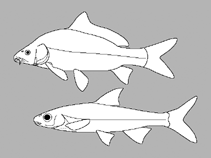
Dorsale stekels (totaal) : 0; Dorsale zachte stralen (totaal) : 10; Anale stekels: 0; Anale zachte stralen: 8. Form compressed and gibbous (Ref. 113713). Inferior limb of pharyngeal bones two-thirds length of superior, a slight external angle; teeth 2.3.5-5.3.2, the inferior of the longer row very small and conic (Ref. 113713). Orbit four times in head, diameter less than length of muzzle, latter rather broad; outline steeply descending from front of dorsal fin; head 4.2 times in length to origin of caudal fin; four well-developed barbels; greatest depth three times in length to origin caudal fin (Ref. 113713). First long dorsal ray weak as the last, and not a spine; ventrals not attaining vent, but reached by the acuminate pectorals (Ref. 113713). Scales large, minutely granular, with few (5-8) and coarse radii (Ref. 113713). Lateral line little deflexed (Ref. 113713).
Colouration: A broad, straight, dark brown band from end muzzle to origin caudal fin, which is light and dark margined above; above dark cinnamon brown, each scale silvered; below paler brown, each scale with a deep brown spot at base; tip of dorsal fin brown (Ref. 113713).
Body shape (shape guide): fusiform / normal.
Total length 4 inches 9 lines (Ref. 113713).
Levenscyclus en paargedrag
Maturiteit | Voortplanting | Paaien | Eieren | Fecunditeit | Larven
Roberts, T.R., 2010. Barbus sensitivus, a new species with extensive pitlines from the Sanaga River (Teleostei: Cyprinidae). aqua, Int. J. Ichthyol. 16(4):187-196. (Ref. 85567)
Status op de Rode Lijst van het IUCN (Ref. 130435: Version 2025-2 (Global))
Gevaar voor de mens
Harmless
Gebruik door de mens
Visserij: van geen belang
Tools
Speciale rapporten
Download XML
Internetbronnen
Schattingen op basis van modellen
Fylogenetische diversiteitsindex (Ref.
82804): PD
50 = 0.5000 [Uniqueness, from 0.5 = low to 2.0 = high].
Bayesian length-weight: a=0.00603 (0.00282 - 0.01286), b=3.06 (2.87 - 3.25), in cm total length, based on LWR estimates for this (Sub)family-body shape (Ref.
93245).
Trofisch niveau (Ref.
69278): 3.0 ±0.3 se; based on size and trophs of closest relatives
Weerstandsvermogen (Ref.
120179): Hoog, minimale populatieverdubbelingstijd minder dan 15 maanden (Preliminary K or Fecundity.).
Kwetsbaarheid van de visserij (Ref.
59153): Low vulnerability (10 of 100).
🛈