>
Cichliformes (Cichlids, convict blennies) >
Cichlidae (Cichlids) > Geophaginae
Etymology: Apistogramma: Greek, apisto = uncertain + Greek, gramma = graphic signal (Ref. 45335); feconat: The new species occurs in the tributaries of the upper and middle Rio Tigre. It is named for the Federation of the Native Communities of the Tigre (FECONAT ) for its struggle to protect the environment of the tribal lands of the local native people from the impact of modern society. A noun in apposition.
Eponymy: This is an acronym referring to the Federation of the Native Communities of the Tigre (FECONAT). [...] (Ref. 128868), visit book page.
Entorno: milieu / zona climática / rango de profundidad / gama de distribución
Ecología
; agua dulce bentopelágico; pH range: 5.8 - ?. Tropical; 27°C - ? (Ref. 104987)
South America: Peru.
Tamaño / Peso / Edad
Madurez: Lm ? range ? - ? cm
Max length : 4.1 cm SL macho / no sexado; (Ref. 104987)
Descripción breve
Claves de identificación | Morfología | Morfometría
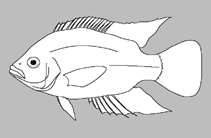
Espinas dorsales (total) : 15 - 17; Radios blandos dorsales (total) : 6 - 7; Espinas anales: 3; Radios blandos anales: 6 - 7; Vértebra: 24. Apistogramma feconat can be diagnosed by the following characters: moderately high-backed, laterally compressed, and moderately elongate; distinct sexual dimorphism and dichromatism. It differs from all other known congeners on the basis of a combination of the following characters: fairly large yellow to orange head and metallic blue or pinkish body in adult males; overall grey slightly hypertrophied lips; bluish or pinkish dorsal fin with slightly prolonged serrated membranes, tips yellowish; large rhombic caudal spot; rounded caudal fin with bright orange to red submarginal and black marginal band; large lateral spot about half body height in females; broad cheek stripe, nape spot, and pectoral spot; small chin spot; squarish throat spot, clearly separated from broad mid-ventral stripe extending onto anal-fin margin (Ref. 104987).
Body shape (shape guide): fusiform / normal.
Appears to be restricted to small clear- or blackwater forest streams with bottom substrate usually red or yellow latosol (Ref. 104987).
Ciclo vital y comportamiento de apareamiento
Madurez | Reproducción | Puesta | Huevos | Fecundidad | Larva
Römer, U., D.P. Soares, C.R.G. Dávila, F. Duponchelle, J.-F. Renno and I. Hahn, 2015. Re-description of Apistogramma payaminonis Kullander, 1986, with descriptions of two new cichlid species of the genus Apistogramma (Teleostei, Perciformes, Geopha-ginae) from northern Peru. Vert. Zool. 65(3):287-314. (Ref. 104987)
Situación en la Lista Roja de la UICN (Ref. 130435: Version 2025-2 (Global))
Amenaza para el ser humano
Harmless
Usos humanos
Herramientas
Informes especiales
Descargar XML
Fuentes de Internet
Estimaciones basadas en modelos
Índice de diversidad filogenética (Referencia
82804): PD
50 = 0.5000 [Uniqueness, from 0.5 = low to 2.0 = high].
Bayesian length-weight: a=0.01820 (0.00837 - 0.03955), b=2.99 (2.82 - 3.16), in cm total length, based on LWR estimates for this Genus-body shape (Ref.
93245).
Nivel trófico (Referencia
69278): 3.3 ±0.4 se; based on size and trophs of closest relatives
Resiliencia (Referencia
120179): Alto, población duplicada en un tiempo mínimo inferior a 15 meses (Preliminary K or Fecundity.).
Vulnerabilidad pesquera (Ref.
59153): Low vulnerability (10 of 100).
🛈