分类 / 名称
俗名 | 同种异名 | Catalog of Fishes(属, 种) | ITIS | CoL | WoRMS | Cloffa
Teleostei >
Siluriformes (Catfishes) >
Loricariidae (Armored catfishes) > Hypoptopomatinae
Etymology: Rhinolekos: Name from the Greek 'rhinos' for nose, nostril and 'lekos' for plate, referring to presence of the lateronasal plate; capetinga: The specific name is taken from the Tupi-guarani dialect in reference to the old and unused name of São João D´Aliança municipality. The name 'capetinga" refers to white, or clear water. A noun in apposition.
环境:氛围 / 气候带 / 深度上下限 / 分布范围
生态学
; 淡水 居于水底的.
分布
领土 | FAO区域 | 生态系 | 标本纪录 | 分布图 | 简介 | Faunafri
South America: Córrego da Branca and córrego Roncador, rio Tocantins basin in Brazil.
大小 / 重量 / 年龄
成熟度: Lm ? range ? - ? cm
Max length : 3.9 cm SL 雄鱼/尚未辨别雌雄; (Ref. 99822)
简单描述
检索表 | 型态特徵 | 形态测量图
背的软条 (总数) : 8 - 9; 臀鳍软条: 6; 脊椎骨: 31.
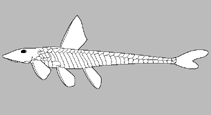
Body shape (shape guide): elongated.
Occurs on flat areas of the córrego da Branca and córrego Roncador, rio Tocantins basin, in areas with shallow clear waters, about 1 m depth and median to fast current flow. Found in association with the vegetation that covers the bottom and the border of the headwaters (Ref. 99822).
生命周期和交配行为
成熟度 | 繁殖 | 产卵场 | 卵 | 孕卵数 | 仔鱼
Roxo, F., L. Orrego, G.C. Silva and C. Oliveira, 2015. Rhinolekos capetinga: a new cascudinho species (Loricariidae, Otothyrinae) from the rio Tocantins basin and comments on it ancestral dispersal route. Zookeys 481:109-130. (Ref. 99822)
世界自然保护联盟红皮书 (Ref. 130435: Version 2025-2 (Global))
临近濒危 (NT) (B1b(iii)+2b(iii)); Date assessed: 22 December 2020
人类利用
工具
特别资料
下载 XML
网络资源
基于模型的估算
系统发育多样性指数 (参考文献
82804): PD
50 = 0.5625 [Uniqueness, from 0.5 = low to 2.0 = high].
Bayesian length-weight: a=0.00977 (0.00434 - 0.02202), b=3.06 (2.87 - 3.25), in cm total length, based on LWR estimates for this (Sub)family-body shape (Ref.
93245).
回复力 (参考文献
120179): 高度, 族群倍增时间少于 15个月 (Preliminary K or Fecundity.).
渔业脆弱性 (Ref.
59153): Low vulnerability (10 of 100).
🛈