Classificazione / Nomi
Nomi Comuni | Sinonimi | Catalog of Fishes(Genere, Specie) | ITIS | CoL | WoRMS | Cloffa
>
Siluriformes (Catfishes) >
Loricariidae (Armored catfishes) > Hypoptopomatinae
Etymology: Curculionichthys: Derived from the from the Latin 'curculionem' (elongated snout) and from the Greek 'ichthys' (fishes), in reference to the relatively elongated snouts of the fish species included in this genus; coxipone: The specific name coxipone refers to the Coxiponé indigenous people who live in the margins of Rio Cuiabá, near the municipality of Cuiabá in Mato Grosso State, Brazil. A noun in opposition.
Eponymy: The Coxiponé indigenous people inhabit the margins of Rio Cuiabá, Mato Grosso, Brazil, where this catfish occurs. (Ref. 128868), visit book page.
Ambiente: milieu / zona climatica / distribuzione batimetrica / gamma di distribuzione
Ecologia
; acqua dolce demersale. Tropical
South America: Rio Cuiaba drainage, Rio Paraguay basin in Brazil.
Dimensione / Peso / Età
Maturità: Lm ? range ? - ? cm
Max length : 2.8 cm SL maschio/sesso non determinato; (Ref. 113800); 3.0 cm SL (female)
Breve descrizione
Chiavi di identificazione | Morfologia | Morfometria
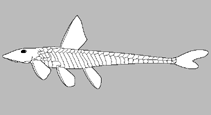
Raggi dorsali molli (totale) : 9; Raggi anali molli: 6; Vertebre: 29 - 30. Curculionichthys coxipone can be diagnosed from all congeners by having 29-30 vertebrae (vs. 28 in all other congeners). It is distinguished from all congeners, except Curculionichthys sabaji and C. paresi by having the cleithrum with an area free of odontodes (vs. cleithrum completely covered with odon¬todes). It further differs from all other species of Curculionichthys with the exception of C. oliveirai by having the anterior profile of the head rounded (vs. pointed); from C. piracanjuba, C. sagarana, and C. oliveirai by having lower lip with some papillae arranged in a medial longitudinal series extending posterior to dentaries through middle portion of lower lip (vs. lower lip with all papillae randomly distributed); from C. insperatus and C. oliveirai by having the caudal fin hyaline, with one dark stripe extending from the caudal peduncle base to the middle caudal fin rays, and dark chromatophores irregularly distributed almost forming one band (vs. caudal fin hyaline, with dark blotch limited to caudal peduncle base); from C. paresi by the absence of contrasting dark-brown geometric spots on the anterior region of the body (vs. presence of dark-brown geometric spots); from C. sabaji by the absence of several dark-brown spots distributed on the body (vs. presence of dark-brown spots); from C. oliveirai and C. coxipone by having the anterior profile of the head pointed (vs. rounded); from C. oliveirai by having 7?9 lateral abdomen plates (vs. 4?5 lateral abdomen plates); from C. paresi by having 9-13 dentary teeth (vs. 4?7); from C. oliveirai by having 6?9 lateral abdomen plates (vs. 4?5); from C. sagarana by absence of one unpaired platelets on dorsal portion of caudal peduncle (vs. presence of one unpaired platelets on dorsal portion of caudal peduncle); from C. piracanjuba by having some papillae on the lower lip arranged in a medial longitudinal series extending posterior to the dentaries through the middle portion of lower lip (vs. lower lip with all papillae randomly distributed) and by not having hypertrophied odontodes on the snout tip (vs. hypertrophied odontodes on the snout tip); from C. insperatus by having small, inconspicuous odontodes forming rows on the head and trunk (vs. large, conspicuous odontodes forming rows on the head and the trunk). In addition, Curculionichthys coxipone is distinguished by the possession of the following characters: interorbital distance 33.8?37.8% of HL ( vs. 27.4?33.6% of HL in C. sagarana); dorsal fin spine 14.9?24.8% of SL (vs. 25.2?27.0% of SL in C. paresi); pectoral fin spine 19.0?25.2% of SL (vs. 27.0?30.1% of SL in C. paresi); mandibular ramus 8.2?12.5% of HL (vs. 6.0?8.0% of HL in C. paresi); and snout length 48.0?58.9% of HL (vs. 67.7?72.7% of HL in C. piracanjuba; 67.0?75.3% of HL in C. luteofrenatus) (Ref. 113800).
Body shape (shape guide): elongated.
Ciclo vitale e comportamento di accoppiamento
Maturità | Riproduzione | Deposizione | Uova | Fecondità | Larve
Roxo, F.F., G.S.C. Silva, L.E. Ochoa and C. Oliveira, 2015. Description of a new genus and three new species of Otothyrinae (Siluriformes, Loricariidae). Zookeys 534:103-134. (Ref. 113800)
Stato della Lista Rossa IUCN (Ref. 130435: Version 2025-2 (Global))
Minaccia per l'uomo
Harmless
Usi umani
Pesca: di nessun interesse
Strumenti
Rapporti speciali
Scarica XML
Fonti Internet
Stime basate su modelli
Indice di diversità filogenetica (Fonte Biblio.
82804): PD
50 = 0.5001 [Uniqueness, from 0.5 = low to 2.0 = high].
Bayesian length-weight: a=0.00977 (0.00434 - 0.02202), b=3.06 (2.87 - 3.25), in cm total length, based on LWR estimates for this (Sub)family-body shape (Ref.
93245).
Livello trofico (Fonte Biblio.
69278): 2.4 ±0.1 se; based on size and trophs of closest relatives
Resilienza (Fonte Biblio.
120179): Alto, tempo minimo di raddoppiamento della popolazione meno di 15 mesi (Preliminary K or Fecundity.).
Vulnerabilità della pesca (Ref.
59153): Low vulnerability (10 of 100).
🛈