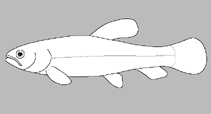
การจำแนกประเภท / ชื่อ
ชื่อสามัญ | ชื่อพ้อง | Catalog of Fishes(สกุล, ชนิด) | ITIS | CoL | WoRMS | Cloffa
>
Characiformes (Characins) >
Erythrinidae (Trahiras)
Etymology: Hoplias: Greek, hoplon = weapon (Ref. 45335); mbigua: Name mbigua is a guaraní word that refers to an aquatic, riverine bird and is the nickname of Isabelino Rodríguez, who worked during many years in the Proyecto Biología Pesquera Regional (Ref. 114112).
Eponymy: Isabelino Rodríguez has the nickname of Mbigua. [...] (Ref. 128868), visit book page.
สิ่งแวดล้อม : สิ่งแวดล้อม / เขตภูมิอากาศ / ระดับความลึก / ระยะการกระจายสินค้า
นิเวศวิทยา
; น้ำจืด กลุ่มสัตว์หน้าดิน,กลุ่มสัตว์พื้นท้องน้ำ. Tropical
South America: Argentina.
ขนาด / น้ำหนัก / อายุ
วัยเจริญพันธุ์: Lm ? range ? - ? cm
Max length : 29.3 cm SL เพศผู้/กระเทย; (Ref. 114112)
คำอธิบายสั้นๆ
เครื่องมือที่ใช้ในการแยกชนิดสัตว์,สิ่งมีชีวิตออกจากกัน | สัณฐานวิทยา | ความยาวต่างๆ
ก้านครีบอ่อนที่หาง (รวม) : 14 - 15; ก้านครีบอ่อนที่ก้น: 9 - 11; สัตว์มีกระดูกสันหลัง: 42. Diagnosis: the presence of tooth-bearing plates on dorsal surface of the basihyal and basibranchials and the medial margins of contralateral dentaries converging towards the mandibular symphysis in ventral view, includes the species in the H. malabaricus group; the presence of 5 brown bands transversely placed on lower jaw distinguishes the new species from its congeners, except H. microlepis (vs. lower jaw with small black or brown dots uniformly distributed or straight); the number of circunpeduncular scales in H. mbigua is 20 whereas H. teres and H. malabaricus have 18 circunpeduncular scales and H. microlepis 22-24, usually 24; Hoplias mbigua has convex dorsal profile between head and dorsal fin and large tooth plate on basihyal whereas H. teres has straight dorsal profile and smaller tooth plates on basihyal; Hoplias mbigua is distinguished from H. microlepis by the presence of 12-16 gill rakers on 1st epibranchial (vs. about 9) and 42-43 lateral line scales (vs. 43-47); Hoplias mbigua has a large supraopercle, with its anterior margin contacting the infraorbitals 5 and 6 whereas the lectotype of H. malabaricus has a short supraopercle, with an anterior margin scarcely extended before anterior opercular margin; Hoplias mbigua is distinguished from H. cf. malabaricus by the dorsal surface of head scarcely or strongly concave (vs. convex in H. cf. malabaricus); a large eye, with the upper margin of orbit strongly marked in skull roof (vs. lateral margin of skull scarcely concave at orbit); the shape of anterior profile of head angular in lateral view (vs. rounded), and the lower head depth 45-50 % of HL (vs. more than 50 % of HL); Hoplias mbigua has a large tooth-plate on basihyal and basibranchials instead of 2 lines of tooth-plates at sides of bones in H. cf. malabaricus; size or shape of basibranchial tooth-plate not observed in the radiograph of the H. malabaricus lectotype (Ref. 114112).
Body shape (shape guide): elongated; Cross section: circular.
วงจรชีวิตและพฤติกรรมการผสมพันธุ์
วัยเจริญพันธุ์ | การสืบพันธุ์ | การวางไข่ | เซลสืบพันธ์ของเพศเมีย(ไข่) | ความดกของไข่ | ตัวอ่อน
Azpelicueta, M.M., M.F. Benítez, D.R. Aichino and C.M.D Mendez, 2015. A new species of the genus Hoplias (Characiformes, Erythrinidae), a tararira from the lower Paraná River, in Misiones, Argentina. Acta Zool Lilloana 59(1-2):71-82. (Ref. 114112)
สถานะบัญชีแดงของ IUCN (Ref. 130435: Version 2025-2 (Global))
ภัยคุกคามต่อมนุษย์
Harmless
การใช้ของมนุษย์
เครื่องมือ
รายงานพิเศษ
ดาวน์โหลด XML
แหล่งที่มาจากอินเตอร์เน็ต
การประมาณค่าตามแบบจำลอง
ดัชนีความหลากหลายทางวิวัฒนาการ (อ้างอิง
82804): PD
50 = 0.5000 [Uniqueness, from 0.5 = low to 2.0 = high].
Bayesian length-weight: a=0.00676 (0.00304 - 0.01503), b=3.12 (2.93 - 3.31), in cm total length, based on LWR estimates for this (Sub)family-body shape (Ref.
93245).
ระดับชั้นอาหาร (อ้างอิง
69278): 4.0 ±0.7 se; based on size and trophs of closest relatives
ความสามารถในการกลับคืนสู่ปกติ (อ้างอิง
120179): ความสูง, เวลาต่ำสุดที่จะทำให้ประชากรเพิ่มขึ้นเป็น 2 เท่าใช้เวลาน้อยกว่า 15 เดือน (Preliminary K or Fecundity.).
ความเสี่ยงต่อการตกปลา (Ref.
59153): Low to moderate vulnerability (26 of 100).
🛈