>
Cypriniformes (Carps) >
Cyprinidae (Minnows or carps) > Barbinae
Etymology: yahyaouii: The species is named after Dr. Ahmed Yahyaoui, who contributed to the knowledge of the fish fauna of Morocco and North Africa (Ref. 114135).
Eponymy: Dr Ahmed Yahyaoui is an oceanographer and marine ecologist who is Professor of Biology in the Faculty of Sciences at the Mohammed V-Agdal University, Rabat, Morocco (1984–present). [...] (Ref. 128868), visit book page.
Ambiente: milieu / zona climatica / distribuzione batimetrica / gamma di distribuzione
Ecologia
; acqua dolce benthopelagico. Subtropical
Dimensione / Peso / Età
Maturità: Lm ? range ? - ? cm
Max length : 18.3 cm SL maschio/sesso non determinato; (Ref. 114135)
Breve descrizione
Chiavi di identificazione | Morfologia | Morfometria
Spine dorsali (totale) : 0; Raggi dorsali molli (totale) : 12; Spine anali: 0; Raggi anali molli: 8; Vertebre: 41 - 43. Diagnosis: This species differs from other species of Luciobarbus by the following combination of characters: 42-45 scales on the lateral line, 8-9 above lateral line and 5-6 below lateral line; insertion of the ventral fin is placed in the same edge of the dorsal fin origin; the last single fin ray is ossified in two/thirds of its length, deeply serrated with teeth in the middle part longer than the width of the ray; barbels long, the first barbel overpasses the preorbital distance while in other species it does not reach the preorbital distance, the second barbel usually has the same length than the postorbital distance while in other species it does not reach the postorbital distance; the ethmoid bone is wider than its length; the dorsal branch of the pharyngeal bone is long and forms an open angle with respect to the inferior branch; vertebrae 41-43; and gill rakers 14-17 (Ref. 114135).
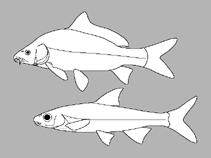
Body shape (shape guide): elongated.
This species is ubiquist generally inhabiting rivers with sandy and gravel substrates and in downstream muddy substrates; it is also present in reservoirs (Ref. 114135). From April to May the species migrates upstream for spawning (Ref. 114135).
Ciclo vitale e comportamento di accoppiamento
Maturità | Riproduzione | Deposizione | Uova | Fecondità | Larve
Doadrio, I., M. Casal-Lopez and S. Perea, 2016. Taxonomic remarks on Barbus moulouyensis Pellegrin, 1924 (Actinopterygii, Cyprinidae) with the description of a new species of Luciobarbus Heckel, 1843 from Morocco. Graellsia 72(2,e054):1-24. (Ref. 114135)
Stato della Lista Rossa IUCN (Ref. 130435: Version 2025-2 (Global))
Minaccia per l'uomo
Harmless
Usi umani
Strumenti
Rapporti speciali
Scarica XML
Fonti Internet
Stime basate su modelli
Indice di diversità filogenetica (Fonte Biblio.
82804): PD
50 = 0.5000 [Uniqueness, from 0.5 = low to 2.0 = high].
Bayesian length-weight: a=0.00617 (0.00304 - 0.01252), b=3.06 (2.89 - 3.23), in cm total length, based on LWR estimates for this Genus-body shape (Ref.
93245).
Livello trofico (Fonte Biblio.
69278): 2.9 ±0.3 se; based on size and trophs of closest relatives
Resilienza (Fonte Biblio.
120179): Alto, tempo minimo di raddoppiamento della popolazione meno di 15 mesi (Preliminary K or Fecundity.).
Vulnerabilità della pesca (Ref.
59153): Low vulnerability (12 of 100).
🛈