Classificatie / Namen
Lokale namen | Synoniemen | Catalog of Fishes(Genus, Soort(en)) | ITIS | CoL | WoRMS | Cloffa
>
Siluriformes (Catfishes) >
Sisoridae (Sisorid catfishes) > Glyptosterninae
Etymology: Exostoma: Greek, exos = outside + Greek, stoma = mouth (Ref. 45335); tenuicaudatum: Derived from the Latin word tenui (slender) and caudata (tail), in reference to the slender caudal peduncle of this species. An adjective.
Milieu: milieu / Klimaatzone / Diepte / verspreidingsgebied
Ecologie
; zoet water demersaal. Subtropical
Asia: Siang River, Brahmaputra River basin in Arunachal Pradesh, India.
Grootte / Gewicht / Leeftijd
Maturiteit: Lm ? range ? - ? cm
Max length : 10.8 cm SL mannelijk / geslacht onbekend; (Ref. 105469)
Korte beschrijving
Determinatiesleutels | Morfologie | Morfometrie
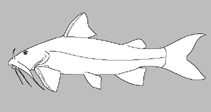
Dorsale stekels (totaal) : 0; Dorsale zachte stralen (totaal) : 6 - 7; Anale zachte stralen: 6. Exostoma tenuicaudata is distinct from its congeners by having an elliptical adhesive pad medially between the anterior margin of the snout and the mid-upper lip margins, further connected posteriorly by a fleshy pad up to the mid-upper lip, and a more slender caudal peduncle (3.6-4.7% SL or 13.8-17.2% CPL). It further differs from its congeners by the following combination of characters: snout length 60.2- 61.8% HL; interorbital width 24.4-26.4% HL; interdorsal distance13.0-13.5% SL; caudal peduncle depth 3.6-4.7% SL and 13.8-17.2% CPL; CPL 26.3-28.0% SL; prepectoral length 16.8-18.9% SL; predorsal length 34.9-39.0% SL; prepelvic length 42.4-44.6% SL; preanal length 68.1-70.1% SL; length of adipose-fin base 30.8-32.9% SL; length of dorsal-fin base 7.9-10.8% SL; length of anal-fin base 3.9-5.3% SL; caudal-fin length 14.3-19.4% SL, maxillary barbel 63.5-72.1% HL, nasal barbel 19.9-26.3% HL; eye diameter 10.0-16.0% HL; pectoral-fin rays 11-12; and adipose-fin not confluent with dorsal-fin base (Ref. 105469).
Body shape (shape guide): elongated.
Occurs in a steeply sloping mountain drainage with fast flowing water, debouching into the Siang River (Brahmaputra River basin), about 3 km from Bomdo village on the main road to Tuting, Upper Siang district, Arunachal Pradesh. Substrates are mostly composed of large, dark-brown boulders and with pebbles, cobbles, concrete fragments of various colors and minute gravels in certain places. The banks have mosses, shrubs, small trees, with larger trees further uphill. The gravel bed was more or less clean, with only a little algal slime over the substratum. Other fish species collected at the type locality are Neolissochilus hexagonolepis, Pseudecheneis sulcata, Garra magnidiscus and Schistura sp. (Ref. 105469).
Levenscyclus en paargedrag
Maturiteit | Voortplanting | Paaien | Eieren | Fecunditeit | Larven
Tamang, L., B. Sinha and S.D. Gurumayum, 2015. Exostoma tenuicaudata, a new species of glyptosternine catfish (Siluriformes: Sisoridae) from the upper Brahmaputra drainage, northeastern India. Zootaxa 4048(3):441-445. (Ref. 105469)
Status op de Rode Lijst van het IUCN (Ref. 130435: Version 2025-2 (Global))
Gevaar voor de mens
Harmless
Gebruik door de mens
Visserij: van geen belang
Tools
Speciale rapporten
Download XML
Internetbronnen
Schattingen op basis van modellen
Fylogenetische diversiteitsindex (Ref.
82804): PD
50 = 0.5002 [Uniqueness, from 0.5 = low to 2.0 = high].
Bayesian length-weight: a=0.00603 (0.00269 - 0.01352), b=3.08 (2.88 - 3.28), in cm total length, based on LWR estimates for this (Sub)family-body shape (Ref.
93245).
Trofisch niveau (Ref.
69278): 3.2 ±0.4 se; based on size and trophs of closest relatives
Weerstandsvermogen (Ref.
120179): Gemiddeld, minimale populatieverdubbelingstijd 1,4-4,4 jaar (Preliminary K or Fecundity.).
Kwetsbaarheid van de visserij (Ref.
59153): Low vulnerability (10 of 100).
🛈