Klassifizierung / Names
Namen | Synonyme | Catalog of Fishes(Gattung, Arten) | ITIS | CoL | WoRMS | Cloffa
>
Siluriformes (Catfishes) >
Auchenipteridae (Driftwood catfishes) > Auchenipterinae
Etymology: Tympanopleura: Greek, tympanon = drum + Greek, pleura = pleura; cryptica: The specific name is derived from the transliterated Greek kryptos (hidden or concealed), in reference to the close morphological and pigmentation similarities of this species to congeners and its previously unrecognized taxonomic distinctiveness. Feminine.
Umwelt: Milieu / Klimazone / Tiefenbereich / Verbreitungsgebiet
Ökologie
; süßwasser benthopelagisch. Tropical
South America: middle and upper Amazon River basin, State of Amazonas in Brazil and Loreto Region in Peru.
Größe / Gewicht / Alter
Geschlechtsreife: Lm ? range ? - ? cm
Max length : 8.5 cm SL Männchen/unbestimmt; (Ref. 103256)
Kurzbeschreibung
Bestimmungsschlüssel | Morphologie | Morphometrie
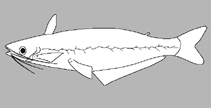
Rückenflossenstacheln (insgesamt) : 2; Rückenflossenweichstrahlen (insgesamt) : 6; Afterflossenweichstrahlen: 23 - 30; Wirbelzahl: 38 - 41. Tympanopleura cryptica is distinct from its congeners by having a unique combination of characters. It is distinguished from T. atronasus in having gill rakers on the first arch 21-26, mode 22 (vs. 14-23, mode 16 ), preanal vertebrae 14-15 (vs. 16-19); total vertebrae 38-41, mode 38 (vs. 39-43, mode 41); pleural rib pairs 4-5 (vs. 7-8), distance between pectoral- and dorsal-fin origin 21.6-24.3% SL (vs. 15.7-20.9% SL), and a uniform body coloration that does not include a dark blotch of melanophores on the flank above the anal-fin base or streaks in the caudal fin, as is typically present in T. atronasus. It can be diagnosed from T. brevis in having anal-fin rays 23-30 (vs. 31-36), pectoral-fin rays 8-10, mode 9 (vs. 10-12, mode 11), and total vertebrae 38 (vs. 38-41, mode 40). It differs from T. longipinna in having anal-fin rays 23-30 (vs. 32-42), pectoral-fin rays 8-10, mode 9 (vs. 10-13, mode 11), preanal vertebrae 14-15, mode 15 (vs. 13-15, mode 14), total vertebrae 38-41, mode 38 (vs. 40-43, mode 43), preanal length 59.6-66.0% SL (vs. 49.7-57.6% SL), distance between dorsal and adipose-fin origin 33.9-46.7% SL (vs. 46.5-54.0% SL), anal-fin base length 24.4-30.3% SL (vs. 33.9-39.9% SL), and eye diameter 16.7-25.6% HL (vs. 11.6-18.5% HL). It is distinguished from T. piperata in having anal-fin rays 23-30 (vs. 31-38), gill rakers on the first arch 21-26, mode 22 (vs. 16- 23, mode 19), total vertebrae 38-41, mode 38 (vs 39-41, mode 40), prepelvic length 48.4-53.6% SL (vs. 41.3-47.0% SL), prepectoral length 29.7-33.8% SL (vs. 23.6-28.3% SL), distance between pectoral and dorsal-fin origin 21.6-24.3% SL (vs. 15.2-20.9% SL), distance between dorsal-and adipose-fin origin 33.9-46.7% SL (vs. 45.9-55.4% SL), anal-fin base length 24.4-30.3% SL (vs. 30.9-39.3% SL), eye diameter 16.7-25.6% HL (vs. 24.3-35.7% HL), presence of two small posterior diverticula on gas bladder (vs. diverticula absent), and base of the caudal fin without a characteristic dark, hourglass-shaped transverse bar usually present in T. piperata. It differs from T. rondoni in having anal-fin rays 23-30, mode 29 (vs. 28-37, mode 31), pectoral-fin rays 8-10, mode 9 (vs. 10-13, mode 11), gill rakers on the first arch 21-26, mode 22 (vs. 24-33, mode 29-30), total vertebrae 38-41, mode 38 (vs. 38-42, mode 40), pleural rib pairs 4-5, mode 5 (vs. 4-6, mode 6), eye diameter 16.7-25.6% HL (vs. 8.4-17.0% HL), gas bladder cordiform and with two short posterior diverticula (vs. gas bladder elongated antero-posteriorly and with two longer, recurved diverticula), and pigmentation on the head and body diffuse and relatively uniform in appearance (vs. prominent spotted pattern) (Ref. 103256).
Lebenszyklus und Paarungsverhalten
Geschlechtsreife | Fortpflanzung | Ablaichen | Eier | Fruchtbarkeit | Larven
Walsh, S.J., F.R.V. Ribeiro and L.H. Rapp Py-Daniel, 2015. Revision of Tympanopleura Eigenmann (Siluriformes: Auchenipteridae) with description of two new species. Neotrop. Ichthyol. 13(1):1-46. (Ref. 103256)
IUCN Rote Liste Status (Ref. 130435: Version 2025-2 (Global))
Bedrohung für Menschen
Harmless
Nutzung durch Menschen
Tools
Zusatzinformationen
Download XML
Internet Quellen
Schätzungen auf der Grundlage von Modellen
Phylogenetischer Diversitätsindex (Ref.
82804): PD
50 = 0.5156 [Uniqueness, from 0.5 = low to 2.0 = high].
Bayesian length-weight: a=0.00871 (0.00408 - 0.01859), b=3.03 (2.85 - 3.21), in cm total length, based on LWR estimates for this (Sub)family-body shape (Ref.
93245).
Trophische Ebene (Ref.
69278): 3.3 ±0.4 se; based on size and trophs of closest relatives
Widerstandsfähigkeit (Ref.
120179): hoch, Verdopplung der Population dauert weniger als 15 Monate. (Preliminary K or Fecundity.).
Anfälligkeit der Fischerei (Ref.
59153): Low vulnerability (10 of 100).
🛈